
The Deficit: Obama vs Bush
3 Feb 2012Ezra Klein takes a crack at comparing the cost of major policy decisions:

OECD Statistics Explorer and Some Other Cool Shit
In: Graphic Design (general) Graphic Tools Innovative Interactive Maps
2 Feb 2012This is an example of why you keep checking back on mediocre data visualization tools. The last time I looked at the OECD’s explorer, it was slow, kinda clunky, and not very innovative. This morning I took another look. Wow! It has interactive choropleth maps, motion scatter plots, profile plots, time graphs, and cool histogram tools – and all of them have excellent filters and fine tuning controls, can be viewed over time, are smoothly animated and you’re allowed to load your own data.

But wait! There’s more! MUCH more! It turns out the explorer is just one tool created by the Swedish National Center for Visual Analytics (NCVA), who have constructed a set of Geovisual Analytics Visualization (GAV) Flash tools, including what you need to create your own statistics explorer. The NCVA also has a spin-off company that sells a desktop version of the explorer, a Flow Map explorer that draws proportionate arrows on maps to track flows, and a multi-dimensional explorer (which I only played with a little – but is very very cool).

Check out the scatter tables in the MDIM as a way to select data in the other two panels:

I’m almost embarrassed I haven’t seen these before. On the other hand, I love that there is such innovation going on – all the time.
European Response to Crisis
1 Feb 2012Almost makes it look like they’ve done a lot:

12 Historic Visualizations
31 Jan 2012


Living in a QE World
31 Jan 2012Another problem brewing. The world is running out of places to kick the credit can. As usual, there is much insight to be gained from the discussion and comments over at Barry Ritholtz’s The Big Picture.


Graphic Enhanced State of the Union Address
In: Innovative Politics
31 Jan 2012The White House released a video of last week’s State of the Union address, with a split screen showing supporting charts, diagrams, and talking points. It’s not a brilliant model of visualization best practices by any stretch of the imagination, but it is a step in the right direction, and represents a recovery from the ridicule that Ross Perot received for using charts on the national political stage in 1992.
For further insight (on both design and economic issues), I HIGHLY RECOMMEND watching this in conjunction with Jodi Beggs critique over at Economists Do it With Models.
How Carbs Make You Fat
31 Jan 2012In my experience, this is very true – whenever I jump off the carb/insulin roller coaster I lose weight very quickly.


I have to say I love the image from the top of the article:

Google Mint!
In: Internet/tech
26 Jan 2012Ok, there’s not much charting going on here, but there is a whole lot of fascinating data on Google ad revenue, as compiled by search marketing company WordStream. It is stunning what companies are paying per click for some of these keywords. In revenge for years of mediocre service (and because it was fun), I just went and searched for “high speed internet deals” then clicked on Comcast’s ad – supposedly costing them >$20. That’ll teach ‘em!
Design wise, this is pretty good. I might have shrunk (or killed) some of the clipart, made the fonts bigger, and tossed in a bar chart at the top instead of those “kind of looks like a chart but isn’t” ribbons – but overall, it works.


NOT a Global Warming Map?
26 Jan 2012The USDA has upgraded it’s plant hardiness map, which is based on average annual extreme temperatures. Horticulturists and gardeners use the maps as a gauge of what types of plants to grow. Some people think the new data indicates that temperatures are rising, and having visible effects on growing seasons and plant diversity. The USDA is (probably wisely) dodging the climate change aspects, pointing out that the methodologies used weren’t quite the same in the two versions. If you want to have fun, do a google news search for “plant hardiness” and see how different media coverage is of this (Chicago Sun Times, ThinkProgress, MSNBC).
The Washington Post used an interactive slider design on their map to let you flip between views of 1990 and 2012:


You can view static and interactive versions at the USDA site, as well as download the dataset.

The Future of Technology
25 Jan 2012An interesting (ok, quick poll: should I stop calling things interesting? I only post stuff I think is interesting – seems a bit redundant, no?) long term look at new technology. At first look, it’s a bit boring and geeky – but the interactive popup descriptions really flesh it out. It would be easy to quibble about where things fall on the timeline, but overall I really enjoyed reading about all the hypothetical tech. Now that we have realized most of the science fiction from the 1900s, it was nice to see that we still have ways to dream and imagine. (via)


Unfolding the Earth
25 Jan 2012An interesting algorithm based method of creating accurate globe projections. (via the Volume Project and NewScientist)
Mapping the earth is a classic problem. For thousands of years cartographers, mathematicians, and inventors have come up with methods to map the curved surface of the earth to a flat plane. The main problem is that you cannot do this perfectly, such that both the shape and size of the surface are depicted properly everywhere. This has intrigued me for a long time. Why not just take a map of a small part of the earth, which is almost perfect, glue neighboring maps to it, and repeat this until the whole earth is shown? Of course you get interrupts, but does this matter? What does such a map look like? To check this out, we developed myriahedral projections.


Red State Socialism
In: Politics
25 Jan 2012Anyone have a better idea of how to visualize this data? It feels like there should be one – but maybe sometimes a table is the right tool for the job.

Browser Market Share
24 Jan 2012Aesthetically this is obviously quite nice. The roll-over data is snappy quick. The color selection is clear and intuitive. But there’s something about these nested arc charts that I just don’t like – they don’t seem like a very good way to illustrate historical data. It was created as a simple example of the Axiis data visualization framework – which offers several other Flex based graphic tools. (Hat tip to Ryan C for sending this along!)

The Strait of Hormuz
In: Interactive Maps Politics
23 Jan 2012This FT map illustrates just how packed things are at the Persian Gulf’s bottleneck. The designers wisely chose to allow viewers to select which layers of information they wanted to see, and also provided useful related information as popups.

Here is the map with all layers turned on – which obviously would have been a disaster without the interactive filtering.

(note: some FT features require a subscription to view)
Manual Photography Cheat Sheet
In: Internet/tech
23 Jan 2012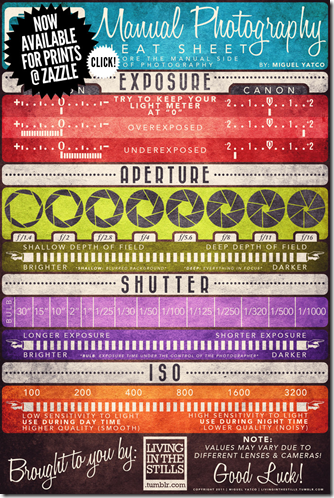


What is Chart Porn?
An addictive collection of beautiful charts, graphs, maps, and interactive data visualization toys -- on topics from around the world.
Categories
- Bailout (118)
- Chartporn Related (3)
- Commentary (21)
- Culture (669)
- Emerging Markets (66)
- Employment (245)
- Environment/weather (133)
- Finance (298)
- Food (92)
- Global Economy (373)
- Graphic Design (bad) (26)
- Graphic Design (general) (183)
- Graphic Tools (23)
- History (158)
- Housing (162)
- Humor (204)
- Innovative (183)
- Interactive (545)
- Internet/tech (97)
- Maps (578)
- News Media (34)
- Politics (329)
- Reference (97)
- Science (331)
- Source: Economist (101)
- Source: FT (92)
- Source: NYT (147)
- Source: Ritholtz (76)
- Source: USA Today (27)
- Source: Washington Post (90)
- Source: WSJ (135)
- Sports (58)
- Stock Market (74)
- Uncategorized (2)
- Updated regularly (76)
- US Economy (553)
- Video (22)
- Aram Korevaar: This chart is now being used as a projection in which countries such as China see themselves as in a [...]
- David: Welcome back Chart Porn! [...]
- J S: Thanks for the great story. Miss reading this blog. Hope to see you more active again. [...]
- jake: I lived in a DC row house for 6 years, and I'm writing this comment from my tiny 1 bedroom apartment [...]
- ronny pettersen: Hilarious and unfortunately accurate... ;-) [...]