
Overfishing
11 Jun 2012http://flowingdata.com/2012/06/06/overfishing-visually-explained/A well narrated video-graphic. (via FlowingData)
Journalists Killed 1992-2011
In: News Media Politics
8 Jun 2012I love that the content was pulled together and includes the names of the victims – but you can barely read the names, and often can’t tell how the countries and names line up.

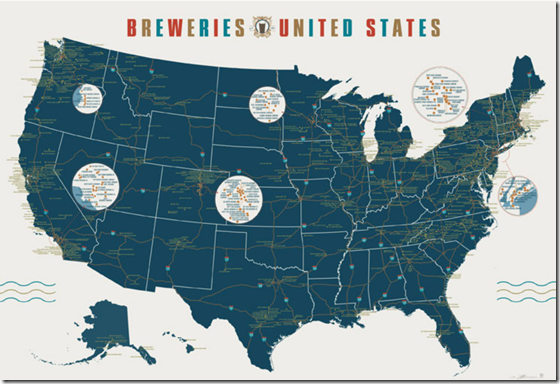
Map of 1000 US Breweries
4 Jun 2012A detailed map from Pop Chart Lab. Has all my favorites on it!
Rent vs Buy
4 Jun 2012The debate over whether it’s cheaper to rent or buy a house is complicated (where you buy, down payment, size of house, etc). But looking at median prices across the nation and current insanely low mortgage rates can make now look like the best time in a while to buy. Read the comment thread on the linked blog if you want more nuance.

If you want even more nuance, particularly if you’re buying a house as an investment, I recommend Barry Ritholtz’s 5 part article Debunking the Housing Recovery Story.
From The Economist:
OUTSIDE China, people tend to assume that the country’s impressive economic growth is due to exports. As the chart below, drawn from our special report on China’s economy, shows, this notion has always been exaggerated and is now plain false. China grows thanks to high levels of investment—far higher than those seen in previous Asian miracles such as South Korea and Japan. The corollary of this is low levels of private consumption. Some argue that this must lead to imbalances that one day will send China’s economy off a cliff. We disagree.

French Open Tracker
30 May 2012Interesting scatter plot of service and return performance. Grey dots indicate players already out of the tournament. I don’t like that the top players are indicated with bigger circles – I think a color indicator would have been better, but perhaps the intention was to make them easier to click on? Content wise, it appears that you need both a service and return game to win (which I suppose is no surprise).

Nerd, Dork, Geek
In: Culture
30 May 2012Why do we almost always use “three” circles for venns? Could this diagram have benefited from another circle?

Everyone Go Swimming!
In: Housing Interactive Maps
25 May 2012A nice map of estimated US mortgages underwater (owe more than it’s worth) from Zillow. Interesting data, but the color ranges are too close in hue for my eyes. When I zoomed into Washington DC I couldn’t tell which range was which unless I used the rollover. I also had a question about the data: how could you end up >200% underwater? (via The Big Picture)

Women on the Net
In: Internet/tech
23 May 2012I usually ignore internet-meta graphics – I just don’t find navel gazing particularly interesting. In addition I would question the reliability of self-reported gender for most of these sites.

Avengers Visualize!
In: Culture Innovative
22 May 2012Every once in a while you stumble upon an obsessive hobby niche with some really stunning visualizations. Today’s obsession: Avengers comic books and the work of Jer Thorp. It turns out that there is a massive database of comic book metadata to work with.
The covers of every Avengers issue:

Who appears in each issue, by date:

Jer goes on to look at Avengers by first appearance, sex, robot, gods, and in part II who appeared more, who created the characters, and so on. I only wish he had shared more about how he built the visualization tools.
Compendium of Advanced Graphics Tools
In: Graphic Tools
18 May 2012The skilled designers over at datavisualization.ch pulled together this list of preferred applications, code libraries, and tools. Dig in! I wish I had time to learn them all. Sigh.

How Would You Cut Defense?
18 May 2012The NYT presents a list of options for you to decide how to trim defense spending. As usual, it’s not quite as easy as you might think – but I still got it up over $800 billion. I like this interactive way of educating people about budget issues.

50 Years of Government Spending
In: Politics US Economy
18 May 2012I usually don’t like viewing stacked bars over time – it’s too hard to see what’s changing. This one still isn’t perfect, but the deficiencies are moderated somewhat by clear labels and only having the three columns. Content wise, it’s pretty fascinating too.

The Rise of the Filibuster
15 May 2012To understand this chart you have to be quite the congressional procedure wonk. I think they should at least have to go back to having to talk the whole time. While standing on one foot. In uncomfortable shoes. With their mom watching.

Women in Parliament
15 May 2012We’ve looked at female world leaders before. Here are some stats on representation (well, what is supposed to be representation).


What is Chart Porn?
An addictive collection of beautiful charts, graphs, maps, and interactive data visualization toys -- on topics from around the world.
Categories
- Bailout (118)
- Chartporn Related (3)
- Commentary (21)
- Culture (669)
- Emerging Markets (66)
- Employment (245)
- Environment/weather (133)
- Finance (298)
- Food (92)
- Global Economy (373)
- Graphic Design (bad) (26)
- Graphic Design (general) (183)
- Graphic Tools (23)
- History (158)
- Housing (162)
- Humor (204)
- Innovative (183)
- Interactive (545)
- Internet/tech (97)
- Maps (578)
- News Media (34)
- Politics (329)
- Reference (97)
- Science (331)
- Source: Economist (101)
- Source: FT (92)
- Source: NYT (147)
- Source: Ritholtz (76)
- Source: USA Today (27)
- Source: Washington Post (90)
- Source: WSJ (135)
- Sports (58)
- Stock Market (74)
- Uncategorized (2)
- Updated regularly (76)
- US Economy (553)
- Video (22)
- Aram Korevaar: This chart is now being used as a projection in which countries such as China see themselves as in a [...]
- David: Welcome back Chart Porn! [...]
- J S: Thanks for the great story. Miss reading this blog. Hope to see you more active again. [...]
- jake: I lived in a DC row house for 6 years, and I'm writing this comment from my tiny 1 bedroom apartment [...]
- ronny pettersen: Hilarious and unfortunately accurate... ;-) [...]