
California Shooting Location Map
2 Jan 2013An amusing map from 1927, showing which areas of California could be used to film movies that you wanted to look like other parts of the world.

Helical Orbits
26 Dec 2012DC Metro Station Traffic
In: Maps
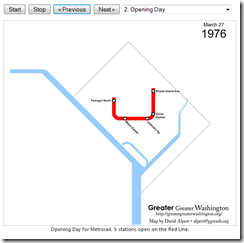
21 Dec 2012Interesting analysis of metro traffic. But I am always left wanting by ordinal rankings. Perhaps coloring the stations themselves in a heatmap manner while desaturating the line colors would have been more useful.


On the same site is the awesome “Evolution of Metrorail” utility that let’s you cycle through the opening of new stations since 1976:
Video Games (1975-2011)
21 Dec 2012Games by genre, and games by platform. Labeling the axis might have been useful – I assume it’s supposed to be percent of total, with the space at top “other”? I tried to find the original source for this, but had no luck.

Infographic Vector Graphics
In: Graphic Tools
20 Dec 2012Yes, I know everyone out there is a master at Illustrator and can create any image they want in mere moments. Ha! But why re-invent the wheel?!? There are a lot of cool free and pay collections of vector elements out there for re-purposing in your own creations.
First off, there’s one of my all-time personal favorites: The Noun Project. The simplicity of symbols convey a lot of power. The noun project usually has multiple versions of any noun you an think of. Some are free, some ask that you attribute the creator, and some are royalty-free for a fee.

If you don’t mind spending just a few bucks ($3-6 on average), head over to graphicriver and do a search for “infographic” or “charts”. Sure, a lot of the packages are full of tacky design – but remember, these are just time-saving ingredients for your next masterpiece.


If you are more comfortable with Photoshop, there are also decent bitmap based templates:


Why did I save the free ones for last? Because they aren’t very good, to be honest. Most of the free templates I found include only the most basic of shapes.


Anyone have any other recommendations?
Timeline Wizardry
20 Dec 2012Timelines are underutilized visualization tools – partially because they are a huge pain in the ass to create. Nate Kogan describes his experience using Timeline.Verite.Co’s nifty javascript timeline creation tool to convert stories stored in a google spreadsheet into a beautiful way to view history.

Bird Family Tree
In: Science
20 Dec 2012A Yale-led scientific team has produced the most comprehensive family tree for birds to date, connecting all living bird species — nearly 10,000 in total — and revealing surprising new details about their evolutionary history and its geographic context. (summary article; another)
It looks like someone did an amazing amount of research into bird diversification. But I can’t really understand all of what this visualization is telling me because the original article is hidden behind a paywall at Nature.

Pythagorean Theorem
In: Science
18 Dec 2012Sometimes the best way to explain something is to demonstrate it.

What’s Killing People
18 Dec 2012The Institute for Health Metrics and Evaluation collects detailed information on global health issues, and produces a number of interesting visualizations.
How people died in 2010 – by cause, age, and filterable by sex and region:

Life expectancy in the US (1989-2009). Who knew it varied so much?

Drill-downable US Causes of Death (1970-2006)

and many many more.
Oskar Fischinger
18 Dec 2012I dabble in VJ’ing, and it’s amazing what you can do with todays tools, like Resolume. But take a look at what Oskar Fischinger did back in 1938 with pieces of paper hanging from wires in his synesthetic interpretation of Liszt’s Hungarian Rhapsody. Amazing. Actually, it’s kind of embarrassing. We are so spoiled.
A cool real time synced visualization of guitar riffs and their matching tabs notations. Apparently the Soundslice site let’s you annotate any youtube video in such a way. I love internet functionality mashups like this.

Infographic SEO Spammers
14 Dec 2012I receive dozens of infographics a day. Most of them (besides being terrible) are obviously designed to promote a particular company or non-profit. However, there are also a lot concerning topics that have nothing to do with their original site– and I figured they were just link-bait for SEO chasers. Well, Dan Tynan did a little more digging in an article over at ITWorld, and it’s quite interesting.

17 Ways to Tie Shoes
12 Dec 2012A practical combination of diagram and example. Simple is usually best.

Caffeine Database
In: Food
12 Dec 2012Not really a chart, but it is an excellent interactive table for comparing the amount of caffeine in different drinks – both by total for a typical serving, and by the ounce.


What is Chart Porn?
An addictive collection of beautiful charts, graphs, maps, and interactive data visualization toys -- on topics from around the world.
Categories
- Bailout (118)
- Chartporn Related (3)
- Commentary (21)
- Culture (669)
- Emerging Markets (66)
- Employment (245)
- Environment/weather (133)
- Finance (298)
- Food (92)
- Global Economy (373)
- Graphic Design (bad) (26)
- Graphic Design (general) (183)
- Graphic Tools (23)
- History (158)
- Housing (162)
- Humor (204)
- Innovative (183)
- Interactive (545)
- Internet/tech (97)
- Maps (578)
- News Media (34)
- Politics (329)
- Reference (97)
- Science (331)
- Source: Economist (101)
- Source: FT (92)
- Source: NYT (147)
- Source: Ritholtz (76)
- Source: USA Today (27)
- Source: Washington Post (90)
- Source: WSJ (135)
- Sports (58)
- Stock Market (74)
- Uncategorized (2)
- Updated regularly (76)
- US Economy (553)
- Video (22)
- Aram Korevaar: This chart is now being used as a projection in which countries such as China see themselves as in a [...]
- David: Welcome back Chart Porn! [...]
- J S: Thanks for the great story. Miss reading this blog. Hope to see you more active again. [...]
- jake: I lived in a DC row house for 6 years, and I'm writing this comment from my tiny 1 bedroom apartment [...]
- ronny pettersen: Hilarious and unfortunately accurate... ;-) [...]