
Science Archive:
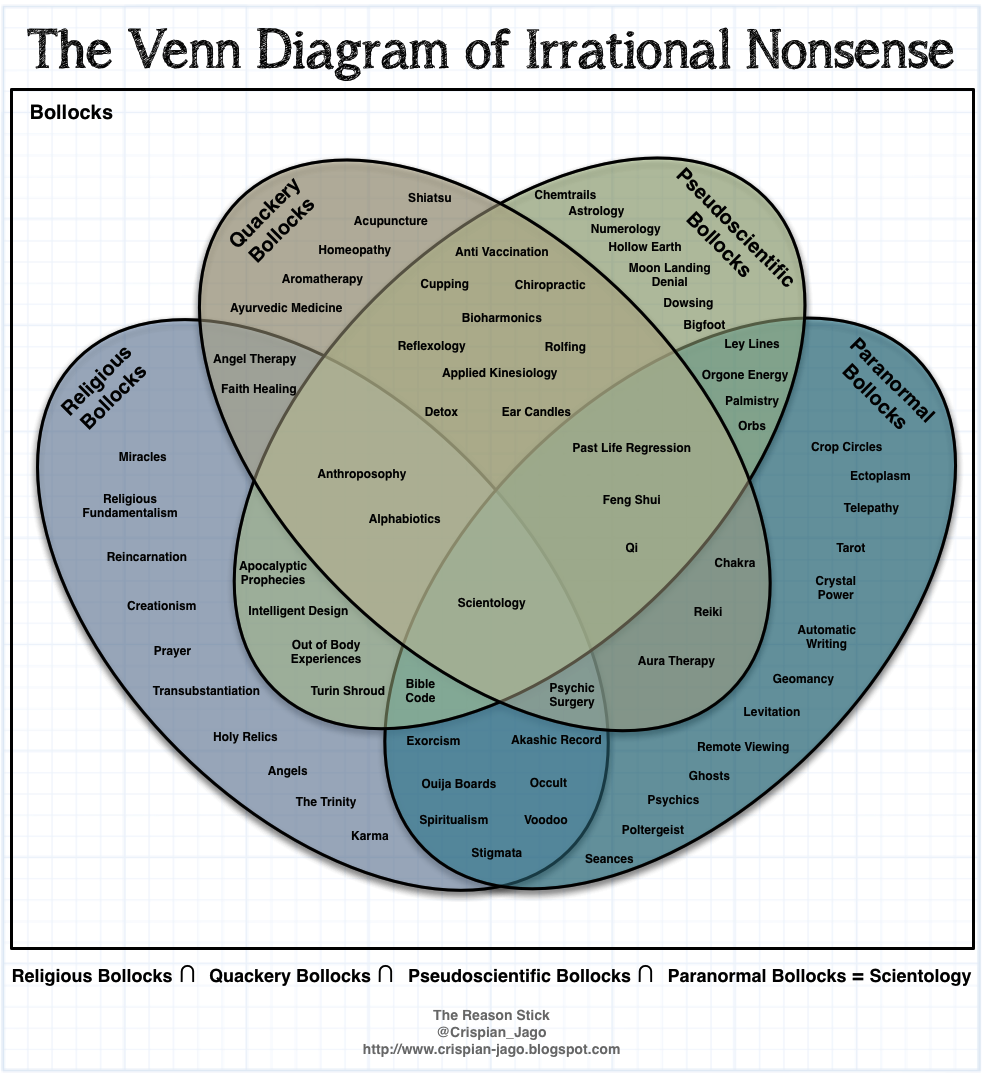
Venn Diagram of Irrational Nonsense
24 Mar 2013I don’t know that this works that great as a venn, but I like having list of nonsense all in one place to remind me how much of it there is.
Climate Change
13 Mar 2013Recent studies add to the evidence that we are changing the world:


If you want to see what “climate change” really means, as in what will be changing where, check out the 2013 National Climate Assessment report. It’s fantastic, and chuck full of visualizations:

One side effect: More shipping in the Arctic:

Rich People Live Longer
11 Mar 2013I suppose this shouldn’t be surprising – and it’s interesting in terms of proposed changes to social security. (related article)

Interesting chart in that it combines life expectancy with "percentage of healthy years”. I’ve heard that a lot of medical research now isn’t necessarily to make you live longer, but for you to be healthy as long as possible, then fall apart all at once and die quickly.

Immigration / Emigration
In: Interactive Science
28 Feb 2013A very slick interactive tool for exploring world migration.

Not much of a graph design wise, but it does drive home the data to vaccine skeptics. Get your shots!!

You are unlikely to die… oh wait
15 Feb 2013Which of these do you worry about?

Helical Orbits
26 Dec 2012Bird Family Tree
In: Science
20 Dec 2012A Yale-led scientific team has produced the most comprehensive family tree for birds to date, connecting all living bird species — nearly 10,000 in total — and revealing surprising new details about their evolutionary history and its geographic context. (summary article; another)
It looks like someone did an amazing amount of research into bird diversification. But I can’t really understand all of what this visualization is telling me because the original article is hidden behind a paywall at Nature.

Pythagorean Theorem
In: Science
18 Dec 2012Sometimes the best way to explain something is to demonstrate it.

What’s Killing People
18 Dec 2012The Institute for Health Metrics and Evaluation collects detailed information on global health issues, and produces a number of interesting visualizations.
How people died in 2010 – by cause, age, and filterable by sex and region:

Life expectancy in the US (1989-2009). Who knew it varied so much?

Drill-downable US Causes of Death (1970-2006)

and many many more.
17 Ways to Tie Shoes
12 Dec 2012A practical combination of diagram and example. Simple is usually best.

Nuclear Weapons, Reactors, and Mining
In: Science
12 Dec 2012At first I didn’t like it – too busy and radial diagrams are always annoying. Then I looked at the information and realized there was quite a lot there. Then I started looking at the legend and realized the information isn’t really clear. So now I don’t like it again.

How Frequent is Your Birthday?
28 Nov 2012Very nice heat chart. I wonder what would happen if you filtered by geography? An awful lot of people I knew in northern NY were born 9 months after the cold dark winter.

More colorful Tableau version:

Brain Size and Diet
In: Science
8 Nov 2012I love these evolutionary causation theories.
A study published yesterday in the journal PNAS puts weight behind the hypothesis that–more than any social or environmental factor–humans own their giant cognitive leap to the ancestral chefs and proto grill masters who invented cooked food.
Why? According to the researchers, a diet of raw foods can’t support an endless growth of both brawn and brains. Larger body sizes and bigger brains both meant more energy use, which meant more time spent eating each day.
And, since no primate can sustain a daily foraging requirement of much more than eight hours (gorillas average close to eight, but sometimes spend closer to nine), our ancestors must have found some way to get more energy in less time.
I don’t know that I buy the summary argument, but viewing “time spent getting calories” as a driver of intelligence and socialization selection is intriguing.

Thanks to Will T. for sending in the link!
The Truth about Natural Cold Remedies
2 Nov 2012A great diagram about different options and their efficacy. The related article goes into more detail on each remedy.


What is Chart Porn?
An addictive collection of beautiful charts, graphs, maps, and interactive data visualization toys -- on topics from around the world.
Categories
- Bailout (118)
- Chartporn Related (3)
- Commentary (21)
- Culture (669)
- Emerging Markets (66)
- Employment (245)
- Environment/weather (133)
- Finance (298)
- Food (92)
- Global Economy (373)
- Graphic Design (bad) (26)
- Graphic Design (general) (183)
- Graphic Tools (23)
- History (158)
- Housing (162)
- Humor (204)
- Innovative (183)
- Interactive (545)
- Internet/tech (97)
- Maps (578)
- News Media (34)
- Politics (329)
- Reference (97)
- Science (331)
- Source: Economist (101)
- Source: FT (92)
- Source: NYT (147)
- Source: Ritholtz (76)
- Source: USA Today (27)
- Source: Washington Post (90)
- Source: WSJ (135)
- Sports (58)
- Stock Market (74)
- Uncategorized (2)
- Updated regularly (76)
- US Economy (553)
- Video (22)
- Aram Korevaar: This chart is now being used as a projection in which countries such as China see themselves as in a [...]
- David: Welcome back Chart Porn! [...]
- J S: Thanks for the great story. Miss reading this blog. Hope to see you more active again. [...]
- jake: I lived in a DC row house for 6 years, and I'm writing this comment from my tiny 1 bedroom apartment [...]
- ronny pettersen: Hilarious and unfortunately accurate... ;-) [...]