
Maps Archive:
Map: Geographic Income
28 Jun 2011National Geographic mashed together income-level and population distribution to make this beautiful map.

Mortgage Denial Rates
In: Housing Interactive Maps
27 Jun 2011Percent of mortgage applications that were denied in 2010. “In all, the nation’s 10 largest mortgage lenders denied 26.8% of loan applications in 2010, an increase from 23.5% in 2009.”

Foreclosures
In: Housing Maps Source: NYT
20 Jun 2011The backlog of mortgage delinquencies continues to stagnate after court rulings slowed the process in most states. The housing market won’t really be operating as a “market” for quite some time.

Life Expectancy
In: Culture Interactive Maps Science Source: Washington Post
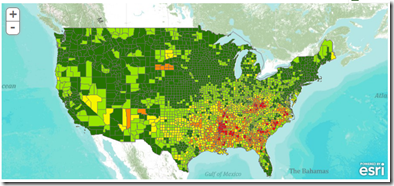
15 Jun 2011Average life expectancy varies a lot by location, gender, and race. International comparisons done by the original study conclude that the US is falling behind the rest of the industrialized world.

From a design point of view, take a look at the below version of the map from the original study — the use of a higher contrast color scheme and non-linear legend ranges results in a more striking view of the results. I’m not sure which one I like better. The top one is more information rich and cleaner – but the bottom one slaps you in the face with meaning.
Immigrants Highly Skilled
9 Jun 2011Despite public perception of immigrants as being poorly educated, the high-skilled U.S. immigrant population today outnumbers the low-skilled population. (related article; original study)


Indian Reservations Missing From Google Maps
8 Jun 2011I don’t know how I never noticed this before – but Google Maps does not include American Indian reservations on it’s maps. WTF? Below are Google’s map of Arizona, and the Bureau of Indian Affairs’ map of reservations in that state:


For comparison, below are Bing and Mapquest’s maps, which do identify the reservations:
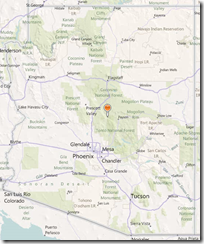
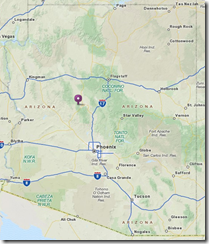
Weird. I can drill down a map until I see a photo of my front door, but Google can’t label sovereign nations occupying millions of acres of land?!? (via, via)
Living in the Danger Zone
7 Jun 2011A map of every FEMA emergency since 1953 – you can also filter by disaster type.
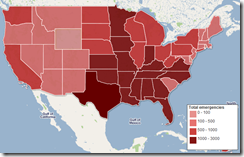
Here’s a slightly more detailed one, for 1964-2010.

Update: and here’s a version from the NYT:

Crime Maps
In: Maps
7 Jun 2011Real estate site Trulia has created crime maps which let you see how violent different neighborhoods are based on data from CrimeReports.com, EveryBlock.com and SpotCrime.com. Below is Philadelphia:

by comparison, here is a similar map produced by the DC metropolitan police department, except this one is a visual piece of crap:

Below is one of the same area produced by spotcrime.com, which I like because it uses cute little little fists, burglars, and spray paint icons:

and for most disturbing map, we have this one from crimereports.com, which in addition to detailed crime information, includes pop-up pictures of registered sex offenders in your neighborhood.

Global Peace Index (2007-11)
7 Jun 2011Based on 23 indicators. Iceland and New Zealand are at the top, with Somalia and Iraq at the bottom. (original study)
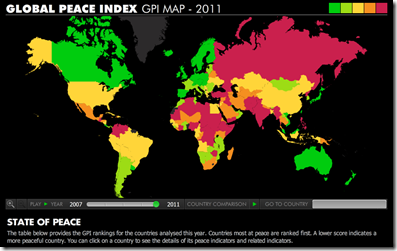
There is also a nice video explaining some of the results and changes over last year.
Mapnificent
In: Interactive Maps
7 Jun 2011Mapnificent shows you what areas you can reach via public transport (or w/bicycle) within any selected amount of time. The example below highlights how far you can go in 30 minutes, starting in downtown Washington DC. Those little bubbles in the suburbs are Metro stops. It is available for most major cities. (blogpost explaining methodology)

London Tube Maps (1889-Today)
In: Interactive Maps
26 May 2011A collection of maps of London’s subway system, illustrating how the system evolved, and how cartography evolved with it. (via)
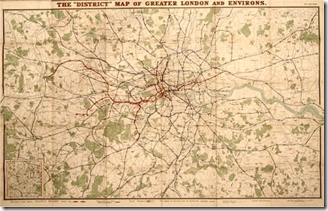

That site contained a link to the “Real Underground” – which is a cool interactive map that lets you morph between Beck’s classic 1933 map, the modern map, and a geographically accurate station map.

Locals vs Tourists
In: Culture Innovative Maps
25 May 2011An analysis of implied preference based on Flickr photos. Blue photos are by locals, red by tourists, yellow could be either. Below are NYC and Washington DC; other cities are available. (via)


Electric Vehicle Charging Stations
23 May 2011Carstations.com lets you search for local charging sites, add new ones, and read reviews/comments about each. Personally, I was surprised there were this many out there.

Starry Starry Night
In: Interactive Maps Science
3 May 2011The Photopic Sky Survey is an interactive 5000 megapixel photograph of the entire night sky stitched together from 37,000+ photos. A beautiful example of data aggregation, annotation, and exploration. One of the coolest parts? It was done by an “amateur” photographer, just because he wanted to. (project site)

Typographic Maps
In: Innovative Maps
28 Apr 2011Gorgeous city maps constructed only using words. Prints are available for Washington DC, NYC, San Francisco, Boston and Chicago. I love these. In fact, I just ordered one.



What is Chart Porn?
An addictive collection of beautiful charts, graphs, maps, and interactive data visualization toys -- on topics from around the world.
Categories
- Bailout (118)
- Chartporn Related (3)
- Commentary (21)
- Culture (669)
- Emerging Markets (66)
- Employment (245)
- Environment/weather (133)
- Finance (298)
- Food (92)
- Global Economy (373)
- Graphic Design (bad) (26)
- Graphic Design (general) (183)
- Graphic Tools (23)
- History (158)
- Housing (162)
- Humor (204)
- Innovative (183)
- Interactive (545)
- Internet/tech (97)
- Maps (578)
- News Media (34)
- Politics (329)
- Reference (97)
- Science (331)
- Source: Economist (101)
- Source: FT (92)
- Source: NYT (147)
- Source: Ritholtz (76)
- Source: USA Today (27)
- Source: Washington Post (90)
- Source: WSJ (135)
- Sports (58)
- Stock Market (74)
- Uncategorized (2)
- Updated regularly (76)
- US Economy (553)
- Video (22)
- Aram Korevaar: This chart is now being used as a projection in which countries such as China see themselves as in a [...]
- David: Welcome back Chart Porn! [...]
- J S: Thanks for the great story. Miss reading this blog. Hope to see you more active again. [...]
- jake: I lived in a DC row house for 6 years, and I'm writing this comment from my tiny 1 bedroom apartment [...]
- ronny pettersen: Hilarious and unfortunately accurate... ;-) [...]