
Interactive Archive:
Mapnificent
In: Interactive Maps
7 Jun 2011Mapnificent shows you what areas you can reach via public transport (or w/bicycle) within any selected amount of time. The example below highlights how far you can go in 30 minutes, starting in downtown Washington DC. Those little bubbles in the suburbs are Metro stops. It is available for most major cities. (blogpost explaining methodology)

London Tube Maps (1889-Today)
In: Interactive Maps
26 May 2011A collection of maps of London’s subway system, illustrating how the system evolved, and how cartography evolved with it. (via)
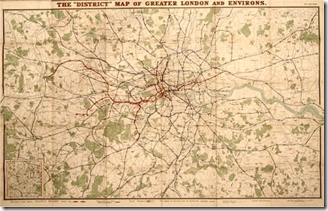

That site contained a link to the “Real Underground” – which is a cool interactive map that lets you morph between Beck’s classic 1933 map, the modern map, and a geographically accurate station map.

Electric Vehicle Charging Stations
23 May 2011Carstations.com lets you search for local charging sites, add new ones, and read reviews/comments about each. Personally, I was surprised there were this many out there.

Where are the Jobs?
In: Employment Interactive Source: Washington Post US Economy
20 May 2011A fantastic annotated heatmap from the Washington Post breaking down job creation/loss by sector. On the right is an interactive, slightly more annotated, line chart version of the same data. I prefer the heatmap. (related article)


Flying Carpet of Middle East Protests
In: Graphic Design (general) Interactive News Media Politics
4 May 2011There were so many of these last month I stopped looking at them – but this one is cute. Yes, I said cute. It’s an interactive flying timeline of protest milestones for 17 countries. Click on any of them to bring up a full Guardian article. They are also keeping it up to date (as of today, anyway).

Guantanamo Prisoners Database
4 May 2011Very nice interactive chart of the history of Guantanamo prisoners, based on some excellent research by the New York Times and NPR. I could point out all the thoughtful design elements going on here, but you’ll figure it out (hint: move the slider on the timeline at the top).

Starry Starry Night
In: Interactive Maps Science
3 May 2011The Photopic Sky Survey is an interactive 5000 megapixel photograph of the entire night sky stitched together from 37,000+ photos. A beautiful example of data aggregation, annotation, and exploration. One of the coolest parts? It was done by an “amateur” photographer, just because he wanted to. (project site)

Human Development Index Tree
27 Apr 2011Visualization of several United Nations indices on education, income, and health. I’m not quite sure what the point of using a “tree” is, but they obviously put some thought into it: The height of the tree trunk is proportional to the total value of the HDI. The size of the three branches are proportional to each sub-indicator. The branches are ordered in increasing order from left to right. The color of the trunk is the average of the color of the components.
Here’s a tree “legend”:

and a comparison of the United States and China:

State Budget Crises
In: Interactive Maps Politics Source: Washington Post US Economy
26 Apr 2011The Washington Post has mapped out a bunch of interesting stats concerning States’ Budget problems: shortfalls, pension liabilities, proposed cuts (health care, education, etc), and who is in charge. To sum up: this is yet another way we’re screwed beyond belief. (related article)


Update: Economic Indicators Dashboard
25 Apr 2011Based on these indicators, things are returning to normal.

How Healthy is Your Housing Market?
In: Housing Interactive Maps
18 Apr 2011Trulia maps out some cool housing price stats: The number of days a listing is on the market before they lower the price, how much they lower it, and the probability it will be lowered again – all by zip code. (via)

This is in addition to Trulia’s existing housing dashboard and heat maps, which are nifty as well:


Where’s Whitey? Census 2010
In: Culture Interactive Maps
11 Apr 2011Interactive map that lets you explore America’s changing demographics by race, as well as the overall population movement between regions:

The below chart lets you compare metropolitan shifts across major cities (though it’s by ranking, which is a little odd):

Patchwork Nation
28 Mar 2011Patchwork Nation tracks a number of traditional economic and social indicators over time – but they also include some interesting alternative ones:
Cracker Barrel restaurants and Whole Foods Stores:


Gun shops and Casinos:


Bankruptcies 2007 vs 2010:


Change in family income 1980-2010:

Nuclear Fear Mongering
19 Mar 2011Ughhh. Type in your zip code and see how close you are to a nuclear plant!! There’s even a red target painted on the reactor!!! I’m primarily posting this so I have an excuse to link to this excellent article, which explains in detail what’s going on in Japan and why you shouldn’t run out to buy potassium pills and start digging a fallout shelter. I might also point out that we conducted 140+ atmospheric atomic tests in Nevada – I’m not saying that was a particularly intelligent or healthy thing to do, but let’s maintain a little perspective about fallout risks, shall we?

Groupon Revenue Deal by Deal
18 Mar 2011$480 million of revenue. Each box is a Groupon deal. The colors identify the city. Width (price) times height (number sold) equals area (revenue). Roll over any deal to see what it was for — lots of weird stuff in there.



What is Chart Porn?
An addictive collection of beautiful charts, graphs, maps, and interactive data visualization toys -- on topics from around the world.
Categories
- Bailout (118)
- Chartporn Related (3)
- Commentary (21)
- Culture (669)
- Emerging Markets (66)
- Employment (245)
- Environment/weather (133)
- Finance (298)
- Food (92)
- Global Economy (373)
- Graphic Design (bad) (26)
- Graphic Design (general) (183)
- Graphic Tools (23)
- History (158)
- Housing (162)
- Humor (204)
- Innovative (183)
- Interactive (545)
- Internet/tech (97)
- Maps (578)
- News Media (34)
- Politics (329)
- Reference (97)
- Science (331)
- Source: Economist (101)
- Source: FT (92)
- Source: NYT (147)
- Source: Ritholtz (76)
- Source: USA Today (27)
- Source: Washington Post (90)
- Source: WSJ (135)
- Sports (58)
- Stock Market (74)
- Uncategorized (2)
- Updated regularly (76)
- US Economy (553)
- Video (22)
- Aram Korevaar: This chart is now being used as a projection in which countries such as China see themselves as in a [...]
- David: Welcome back Chart Porn! [...]
- J S: Thanks for the great story. Miss reading this blog. Hope to see you more active again. [...]
- jake: I lived in a DC row house for 6 years, and I'm writing this comment from my tiny 1 bedroom apartment [...]
- ronny pettersen: Hilarious and unfortunately accurate... ;-) [...]