
Interactive Archive:
Banks: Then and Now
10 Sep 2011Interactive comparison of bank market capitalization, income, and employees. The data are interesting, but the color selection could use more contrast, and the representation of negative values for net income is just bizarre.

Note: some FT features require a subscription.
Fed Crisis Lending to Wall Street
23 Aug 2011Bloomberg compiled some stunning new data on Fed loans to Wall Street banks during the crisis based across multiple programs (Asset-Backed Commercial Paper Money Market Mutual Fund Liquidity Facility, Commercial Paper Funding Facility, discount window, PDCF, TAF, Term Securities Lending Facility and single-tranche open market operations). (related article; via The Big Picture)
I wish I could borrow from the Fed at <2% using junk bonds as collateral.

You get the below charts by selecting multiple banks to compare them:

US Energy Production
In: Interactive Science
16 Aug 2011“More than half of the energy produced in the U.S. isn’t put to use.” A lovely interactive sankey diagram of energy production and waste. As you rollover the diagram it highlights different flows. (via)

Post Offices 1700-1900
In: History Interactive Maps
10 Aug 2011Derek Watkins created this beautiful animated map proxying the expansion of “civilization” across the United States during the 18th and 19th centuries. I particularly like the running timeline at the bottom.
Federal Crimes
1 Aug 2011Interactive graph of federal crimes. I wish it had better dynamic filtering so you could look closer at some of the more interesting categories.

Satellites in Google Earth
In: Interactive Maps Science
25 Jul 2011Real-time mapping of ~13,000 satellite in Google Earth (updated every 30 seconds). Completely ridiculous.

European Bank Stress Tests
21 Jul 2011An interactive map and table of the test results, showing debt levels by bank.


note: access to some FT features require a subscription.
Budget Hero
18 Jul 2011American Public Media created a fun online game where you try to balance the budget by selecting priorities and playing policy cards. The interface is amusing, but does take a few minutes to grasp – watch the introduction. (via)

Mortgage Denial Rates
In: Housing Interactive Maps
27 Jun 2011Percent of mortgage applications that were denied in 2010. “In all, the nation’s 10 largest mortgage lenders denied 26.8% of loan applications in 2010, an increase from 23.5% in 2009.”

Try Your Hand at Saving Social Security
18 Jun 2011Interactive tool from the WSJ. Select benefit reductions, tax increases, and/or benefit increases to see if you can make it solvent. (note: to get around WSJ paywall, google search for “saving social security wsj” then jump to the tool using the result there)

Magic Carpet Timeline of Modern Music
In: Culture Interactive
17 Jun 2011The Guardian re-used the slick interface last seen detailing Middle East Protests to explore modern music. You can also filter by genre if you want. Me likey!

Hollywood Career-o-Matic
In: Culture Interactive
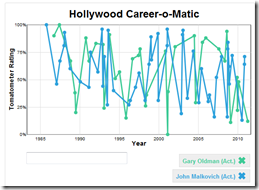
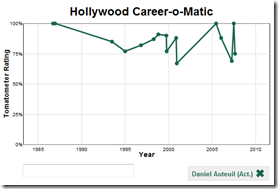
15 Jun 2011Chart the career of major actors and directors, based on Rotten Tomatoes’ aggregation of reviews – just type in who you want to see. Below are John Malkovich and Gary Oldman (who have had very busy diverse careers), and Daniel Auteuil, who has the highest consistent rating. If nothing else, it’s a cool way to explore movies – the rollovers remind you of precisely what bombs you have been erasing from your memory. (via FlowingData)
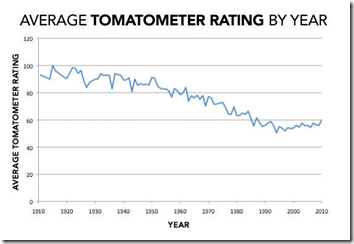
The Slate article also compiles some interesting aggregate stats. For example, on average, movies have been getting worse:
Life Expectancy
In: Culture Interactive Maps Science Source: Washington Post
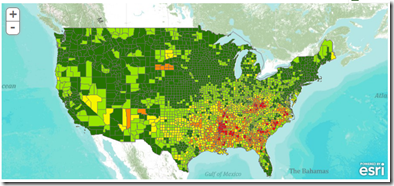
15 Jun 2011Average life expectancy varies a lot by location, gender, and race. International comparisons done by the original study conclude that the US is falling behind the rest of the industrialized world.
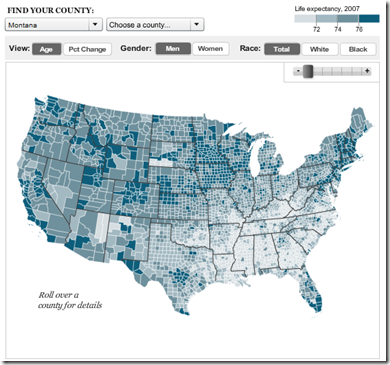
From a design point of view, take a look at the below version of the map from the original study — the use of a higher contrast color scheme and non-linear legend ranges results in a more striking view of the results. I’m not sure which one I like better. The top one is more information rich and cleaner – but the bottom one slaps you in the face with meaning.
Global Peace Index (2007-11)
7 Jun 2011Based on 23 indicators. Iceland and New Zealand are at the top, with Somalia and Iraq at the bottom. (original study)
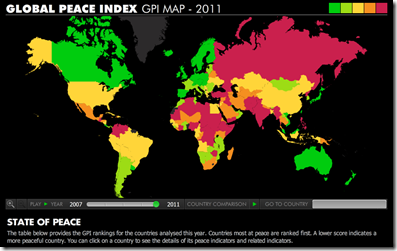
There is also a nice video explaining some of the results and changes over last year.


What is Chart Porn?
An addictive collection of beautiful charts, graphs, maps, and interactive data visualization toys -- on topics from around the world.
Categories
- Bailout (118)
- Chartporn Related (3)
- Commentary (21)
- Culture (669)
- Emerging Markets (66)
- Employment (245)
- Environment/weather (133)
- Finance (298)
- Food (92)
- Global Economy (373)
- Graphic Design (bad) (26)
- Graphic Design (general) (183)
- Graphic Tools (23)
- History (158)
- Housing (162)
- Humor (204)
- Innovative (183)
- Interactive (545)
- Internet/tech (97)
- Maps (578)
- News Media (34)
- Politics (329)
- Reference (97)
- Science (331)
- Source: Economist (101)
- Source: FT (92)
- Source: NYT (147)
- Source: Ritholtz (76)
- Source: USA Today (27)
- Source: Washington Post (90)
- Source: WSJ (135)
- Sports (58)
- Stock Market (74)
- Uncategorized (2)
- Updated regularly (76)
- US Economy (553)
- Video (22)
- Aram Korevaar: This chart is now being used as a projection in which countries such as China see themselves as in a [...]
- David: Welcome back Chart Porn! [...]
- J S: Thanks for the great story. Miss reading this blog. Hope to see you more active again. [...]
- jake: I lived in a DC row house for 6 years, and I'm writing this comment from my tiny 1 bedroom apartment [...]
- ronny pettersen: Hilarious and unfortunately accurate... ;-) [...]
Households Like You
In: Commentary Interactive Source: NYT
20 Jun 2011Select your household type (married, kids, rooomies, etc) and view some summary statistics from the American Community Survey.