
Culture Archive:
Mapping America
15 Dec 2010The NYT’s has created a huge variety of interactive maps based on the Census Bureau’s American Community Survey. Click on “view more maps” to see different breakdowns (income, race, housing, education). Roll-overs popup details at the county or census area level. Related article.
Here’s the percentage of foreign born population in Washington DC:

Change in income level since 2000:

This one shows how racially divided DC still is (green vs blue)”:

They also used the data for some more detailed analysis, such as “How NYC’s Racial Makeup has changed since 2000” (clockwise from upper left: white, hipanic, asian, black). Related article.




A Decade of Facts and Figures
15 Dec 2010I suppose we should prepare ourselves for the inevitable deluge of “end of decade” infographics. The below are from Time Magazine (which also has already compiled 40+ 2010 top ten lists – ick.)


Facebook Friends
In: Culture Internet/tech Maps
14 Dec 2010Facebook engineering intern Paul Butler mapped out a global network of 10 million friendships. Some interesting things about the image: there aren’t any country outlines on the map – the countries “appear” as drawn by the network lines themselves; China, Russia, and Brazil are barely visible because they are dominated by non-Facebook social networks


Girl Talk Deconstructed
In: Culture
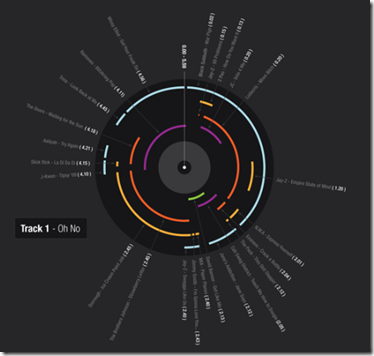
9 Dec 2010Girl Talk’s new mashup album “All Day” is actually quite good (though I sometime wish he had a longer attention span). Tiffany Farrant has deconstructed the samples used in each track into some nifty diagrams.
Sketchy Santas
4 Dec 2010… the number of Santas available and a parent’s desire to have their children see St. Nick in a timely manner, loosely determines the potential sketchiness of Santas in your area. As demand (D) increases, you can expect a corresponding increase in quantity (Q) or available Santas and the sketchiness (S) of any given Santa. (via)

History of Social Media (550bc to 2010)
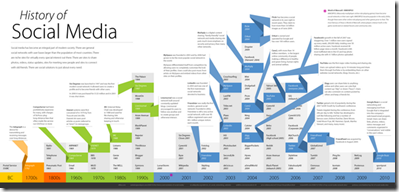
3 Dec 2010A pretty annotated timeline. Not much new here, and it seems a bit redundant to put the date on every cell, considering that they’re organized by column. (via)
Stoning to Death
In: Culture
2 Dec 2010Wow. It turns out that how they stone people to death, according to Islamic Penal Code, is actually much much worse than I had imagined it. Related story. (via)


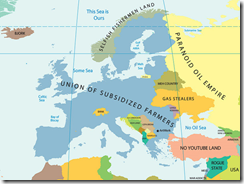
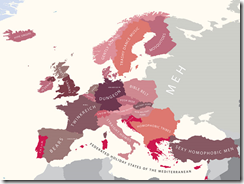
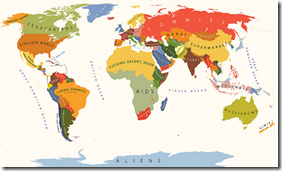
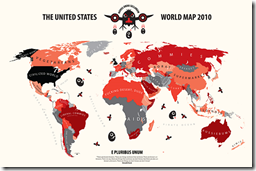
Some additional entertaining stereotypical cartography. My favorite is “Europe According to the Vatican”. All part of Yanko Tsvetkov’s Mapping Stereotypes project.


An awesome map of stereotypical American views of the world:
Falling TV Subscriptions
22 Nov 2010For the first time since the dawn of cable TV, the number of U.S. households paying for TV subscriptions is falling, marking a potential turning point in the TV business.

Part of a multi-part Washington Post Investigation. Each dot represents a death; word clouds illustrate information on the circumstances, sentencing, and other details.

Italian Justice
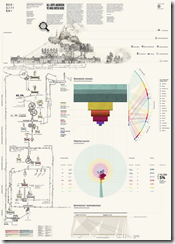
21 Nov 2010A beautiful analysis of the Italian criminal system. Seriously, check it out. Why don’t our crime statistics make this much sense?!
Why Get Married?
In: Culture Interactive
18 Nov 2010A recent survey examined changing view and practices on marriage, children, and household composition. This interactive from the Pew Research Center laid it out best:(full poll report)

The below analysis from Time Magazine spells some of the subtler points:


Generation Quiz
15 Nov 2010A series of cultural image quizzes leads to a prediction of when you were born. Interesting in theory – but it missed me by about 10 years.
 ‘
‘

The Internet is for Porn
In: Culture
13 Nov 2010SFW. Some interesting stats about internet porn. For example, the least popular day of the year for porn is Thanksgiving, and Utah leads the nation in online porn subscriptions.


What is Chart Porn?
An addictive collection of beautiful charts, graphs, maps, and interactive data visualization toys -- on topics from around the world.
Categories
- Bailout (118)
- Chartporn Related (3)
- Commentary (21)
- Culture (669)
- Emerging Markets (66)
- Employment (245)
- Environment/weather (133)
- Finance (298)
- Food (92)
- Global Economy (373)
- Graphic Design (bad) (26)
- Graphic Design (general) (183)
- Graphic Tools (23)
- History (158)
- Housing (162)
- Humor (204)
- Innovative (183)
- Interactive (545)
- Internet/tech (97)
- Maps (578)
- News Media (34)
- Politics (329)
- Reference (97)
- Science (331)
- Source: Economist (101)
- Source: FT (92)
- Source: NYT (147)
- Source: Ritholtz (76)
- Source: USA Today (27)
- Source: Washington Post (90)
- Source: WSJ (135)
- Sports (58)
- Stock Market (74)
- Uncategorized (2)
- Updated regularly (76)
- US Economy (553)
- Video (22)
- Aram Korevaar: This chart is now being used as a projection in which countries such as China see themselves as in a [...]
- David: Welcome back Chart Porn! [...]
- J S: Thanks for the great story. Miss reading this blog. Hope to see you more active again. [...]
- jake: I lived in a DC row house for 6 years, and I'm writing this comment from my tiny 1 bedroom apartment [...]
- ronny pettersen: Hilarious and unfortunately accurate... ;-) [...]