
(another) US Unemployment Map
In: Employment Maps Source: NYT Updated regularly US Economy
9 Jul 2009Quite similar to the AP map I mentioned last month, the NYT has created a map of national unemployment (with data through May09). Some of the filters are interesting in this version:

Cheap Airlines
In: Innovative
8 Jul 2009CoolInfographics spotted this fascinating comparison of airline expenses. It focuses on European airlines, but it still helps explain why I was able to buy a ticket on Southwest today from coast to coast for only $90.

The Global Happy Planet Index
In: Global Economy Maps
8 Jul 20092009 version just released by the New Economics Foundation. The overall index (which measures “the ecological efficiency with which human well being is delivered”) and it’s components (life expectancy, life satisfaction, and some environmental vectors) can be viewed on an interactive map.

Consumer Spending
In: US Economy
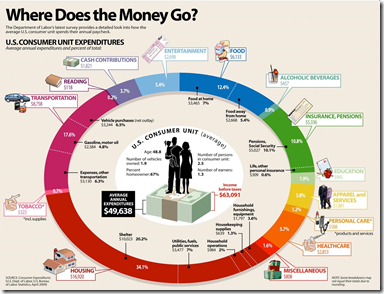
8 Jul 2009Interesting what is “average”. (and I am apparently very much not average).
Who Says We Work Too Much?
In: Culture Innovative Science
8 Jul 2009A compendium of US Holidays, including lots of odd little facts. From Good.

Airline Fees
8 Jul 2009As you plan your summer vacations, a useful table. Spotted by Dataviz. (note the flight change and baggage fees – why does anyone fly those airlines anymore?)

US Health System
8 Jul 2009Good for perspective amidst all the political rhetoric.

Getting Old
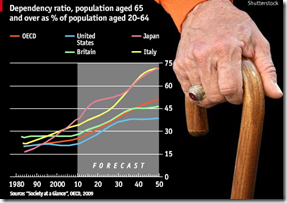
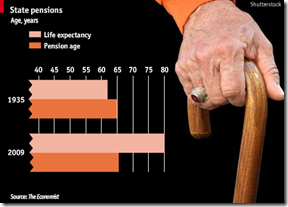
8 Jul 2009Animated charts with talk-over commentary on why most countries’ pension systems are in trouble.
In 1935, when America first introduced state pensions to relieve poverty in old age, the average life expectancy was 62. The official pension age was 65. That meant the cost of the pension system was very modest.
These days people live a lot longer. America’s official pension age is now 66, but people on average retire at 64 and can then expect to draw their pension for 16 years.
The Rich Lost Money Too
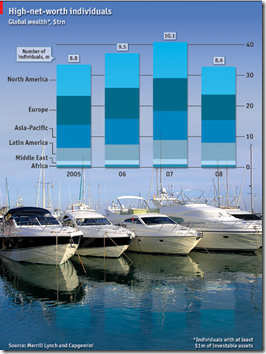
8 Jul 2009But they still have plenty left.
The wealth of the world’s richest people fell by almost a fifth last year to $33 trillion
European Housing Prices (Q109 update)
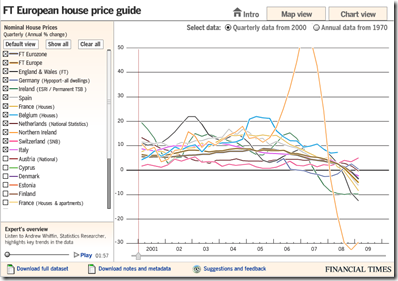
8 Jul 2009In this case, the map view seems not very useful, but the chart view is well done, allowing a view of quarterly data from 2000 as well as annual from 1970. The links to the raw and meta data at the bottom is a nice touch I hope to see more often from everyone. Related article.
Fancy Debt Clock
In: Finance Innovative Reference Updated regularly US Economy
8 Jul 2009Always depressing, this version of the debt clock includes running values of many different kinds of debt, GDP, trade deficits, unfunded liabilities, and other ways we are shooting ourselves in the foot every day. The “about” section is pretty bleak on source details (to put it mildly). Thanks to my friend Jenny Butler for the link.

Recovery Trends
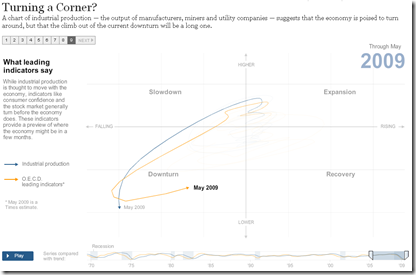
6 Jul 2009The NYT has made a slide presentation of several interesting animations on the recovery. It’s basically a variation of the OECD Business Cycle Clock that I posted about in May, but with a step-through explanation attached. FlowingData points to several similar efforts as well.
History of Our Flag
5 Jul 2009One more July 4th themed infographic to end the weekend. Spotted by CoolInfographics.

Ok, enough war and money. Here are two (stunningly similar) infographics on what goes into all those fireworks. Have a nice holiday weekend everyone!


What is Chart Porn?
An addictive collection of beautiful charts, graphs, maps, and interactive data visualization toys -- on topics from around the world.
Categories
- Bailout (118)
- Chartporn Related (3)
- Commentary (21)
- Culture (669)
- Emerging Markets (66)
- Employment (245)
- Environment/weather (133)
- Finance (298)
- Food (92)
- Global Economy (373)
- Graphic Design (bad) (26)
- Graphic Design (general) (183)
- Graphic Tools (23)
- History (158)
- Housing (162)
- Humor (204)
- Innovative (183)
- Interactive (545)
- Internet/tech (97)
- Maps (578)
- News Media (34)
- Politics (329)
- Reference (97)
- Science (331)
- Source: Economist (101)
- Source: FT (92)
- Source: NYT (147)
- Source: Ritholtz (76)
- Source: USA Today (27)
- Source: Washington Post (90)
- Source: WSJ (135)
- Sports (58)
- Stock Market (74)
- Uncategorized (2)
- Updated regularly (76)
- US Economy (553)
- Video (22)
- Aram Korevaar: This chart is now being used as a projection in which countries such as China see themselves as in a [...]
- David: Welcome back Chart Porn! [...]
- J S: Thanks for the great story. Miss reading this blog. Hope to see you more active again. [...]
- jake: I lived in a DC row house for 6 years, and I'm writing this comment from my tiny 1 bedroom apartment [...]
- ronny pettersen: Hilarious and unfortunately accurate... ;-) [...]