
EU: Lending Down
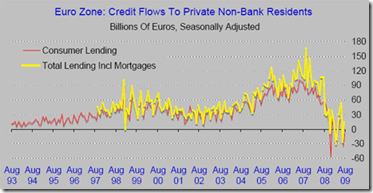
18 Oct 2009We’ve seen this data before for the United States. The below chart confirms the same for the EU: banks are not lending.
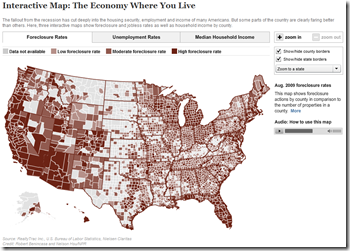
NPR Economy Map
18 Oct 2009Foreclosures, unemployment, and median household income. The scales are a little vague on two of the maps — but it’s ok for broad comparative purposes.
Best City to be Unemployed?
18 Oct 2009Major U.S. cities ranked by their ratio of job postings to unemployed people. Looks like they update this regularly. Spotted over at SimpleComplexity.

Environmental Trends and Basic Data
18 Oct 2009I like this one because it uses colors to represent trends, which is nice when you are trying to display indicators that are on completely different scales.

The same site, the United Nations Environment Programme, has a number of great environment-related infographics:


Marriage
In: Culture Source: NYT
18 Oct 2009Changing trends in overall age and older/younger trends. Related article. (via)

Recovery?
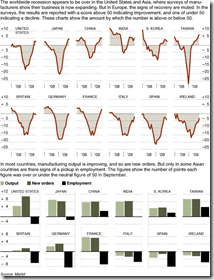
16 Oct 2009Global recovery based on manufacturing output. Related NYT article.
Stimulate Those Jobs
In: Bailout Employment Innovative Interactive Maps Source: USA Today US Economy
16 Oct 2009A funky little interactive map from USA Today. Click on a state on the map and the appropriate little dot on the sorted chart on the right will highlight to show you it’s ranking. When you change the indicator using the drop down box at the top (jobs created/total funds awarded/total funds received/unemployment rate) the dots in the chart all bounce around and resort themselves.

Europeans are a Bunch of Drunks?
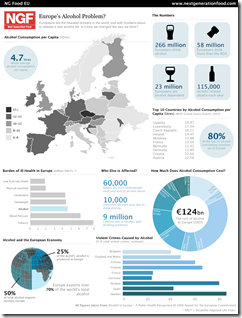
16 Oct 2009Europeans are the heaviest drinkers in the world, with many costs.
Pay Ratios
16 Oct 2009How long would you have to work to earn as much as a top CEO. This infographic uses three different salaries for comparison (minimum wage, average worker, POTUS).

Carry Trade
16 Oct 2009The FT has an annotated animation explaining currency carry trade and it’s effects on markets.


Blog Action Day 2009: Climate Change
15 Oct 2009
In honor of today being 2009’s Blog Action Day, I present below a series of recent climate change visualizations:
First up, “Kyoto: Who’s on Target”, which uses interesting nested circles for indicators of compliance. (via)

From the Washington Post, an interactive view of carbon emissions from G20 countries (either total or per capita) with a slider to move from 1950 through 2006. Easily missed, you can also click on a countries name on a list below that bubble chart (or on the “country profile” tab) to drilldown to individual countries. The October 5 part of the “special report” also contained a nice overview map.


Next, a treemap of cumulative CO2 emissions (1751-2006):

Breathing Earth‘s CO2 emissions simulator:

another interactive CO2 emissions map:

and if you doubt what effects CO2 levels are having, and whether global warming is something to worry about, please go read the “Global Climate Change Impacts in the United States” report.


or take a look at the Climate Orb, which is gathering stories of environmental impacts around the globe:

Cultural Memes
14 Oct 2009Sometimes a good graphic design takes on a life of it’s own.









of course, the original was based on a great photograph:

and if you want to you can make your own.


What is Chart Porn?
An addictive collection of beautiful charts, graphs, maps, and interactive data visualization toys -- on topics from around the world.
Categories
- Bailout (118)
- Chartporn Related (3)
- Commentary (21)
- Culture (669)
- Emerging Markets (66)
- Employment (245)
- Environment/weather (133)
- Finance (298)
- Food (92)
- Global Economy (373)
- Graphic Design (bad) (26)
- Graphic Design (general) (183)
- Graphic Tools (23)
- History (158)
- Housing (162)
- Humor (204)
- Innovative (183)
- Interactive (545)
- Internet/tech (97)
- Maps (578)
- News Media (34)
- Politics (329)
- Reference (97)
- Science (331)
- Source: Economist (101)
- Source: FT (92)
- Source: NYT (147)
- Source: Ritholtz (76)
- Source: USA Today (27)
- Source: Washington Post (90)
- Source: WSJ (135)
- Sports (58)
- Stock Market (74)
- Uncategorized (2)
- Updated regularly (76)
- US Economy (553)
- Video (22)
- Aram Korevaar: This chart is now being used as a projection in which countries such as China see themselves as in a [...]
- David: Welcome back Chart Porn! [...]
- J S: Thanks for the great story. Miss reading this blog. Hope to see you more active again. [...]
- jake: I lived in a DC row house for 6 years, and I'm writing this comment from my tiny 1 bedroom apartment [...]
- ronny pettersen: Hilarious and unfortunately accurate... ;-) [...]
Blame the Smart People?
In: Bailout Commentary Finance Humor Source: WSJ US Economy
18 Oct 2009A WSJ op-ed that presents a convincing argument that we can’t blame stupid people for the financial crisis (though they certainly helped).