
Rigged Trade Rules
In: Global Economy
27 Oct 2009Oxfam has produced a series of six simple, but effective and entertaining, animations that argue how global trade practices are hurting developing countries.

Timeline of recession and recovery (the Adversity Index) from Moodys/MSNBC (1995-2009). You can drill down to individual metro areas by clicking on a state. The Adversity Index page has a number of related articles.

There’s also a map of “recession resistant areas” (has had no more than 9 months of recession over the past 15 years).

Before and After Humans
27 Oct 2009This is part informative and part just plain weird. The informative part is that you can click through the past 7 million years of the human evolutionary tree and view summaries of basic characteristics. The weird part is that it also allows you to click through the next 4 million years and see summaries of how we’re going to mess ourselves up. Apparently this is part of MSNBC’s “Fast Forward: The Future of Evolution” feature.


Who Owns Mortgages?
In: Finance Housing US Economy
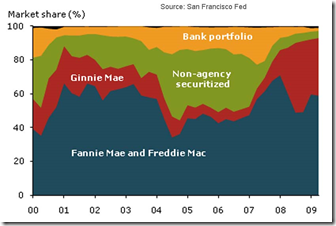
26 Oct 2009Fannie Mae and Freddie Mac combined have consistently been the largest players in the market, owning or guaranteeing about half or more of the mortgages in the sample at any given time. Non-agency securitization peaked in the first quarter of 2006, when it accounted for nearly 40% of new originations. Finally, the share of mortgages retained in the originating institution’s portfolio averaged about 15% throughout the boom, but has fallen considerably since. (from SF Fed via Calculated Risk)
Obama Tracker
26 Oct 2009An odd little tool – it’s a timeline of major economic, domestic policy, and foreign policy events and developments. It’s not clear to me what use the bars are. Perhaps a calendar would have been better?

Visual History of The Federal Reserve
26 Oct 2009Available as a print or free PDF file, from Financial Graph and Art. (via Ritholtz)

UK Quantitative Easing
26 Oct 2009Cumulative total of gilt purchases by the Bank of England. Related article. <insert generic comment about how the mind doesn’t easily distinguish arc lengths in spiral charts>

Google Flu Trends
In: Interactive Maps Science
25 Oct 2009Google uses aggregated google search data to estimate flu activity around the world (for 21 countries at the moment).
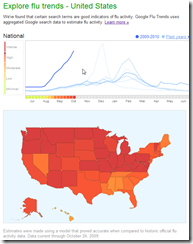
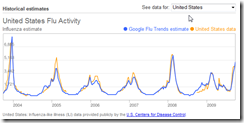
Do you doubt the accuracy of this method? There’s a chart comparing historical CDC reports to the google method:
Health Care Demographics
25 Oct 2009The content is interesting, but I’m posting it just as much for being a good example of “many smalls” design, in this case small maps. (via)

Endangered Species Map
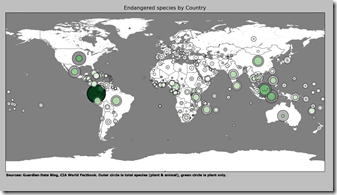
25 Oct 2009The data is only disaggregated at the country level, but it’s still interesting.
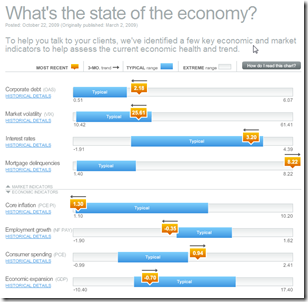
Economic Recovery Dashboard (Oct 09 ver)
24 Oct 2009October update of one of my favorite summaries of economic indicators. If you normally find this stuff confusing you should check it out — click on any of the “historical details” to see what each indicator means and why it’s important.
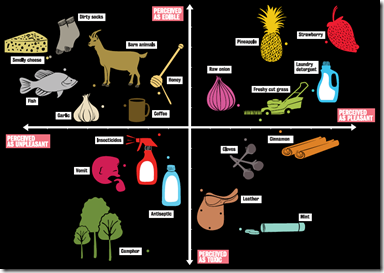
Why You Have a Nose
23 Oct 2009There are two evolutionary reasons for having a nose, runs one theory. The first is to ascertain whether it would be safe to put something in your mouth – to gauge edibility. The second is to advise about whether it would be a good idea to run away
Population Problems
23 Oct 2009A graphic of several countries’ population distribution. The related article points out that while many OECD countries are facing problems because of their aging population, many developing countries are dealing with the opposite. Uganda, for example has 70 percent of the population under 30.

Russia vs USA
23 Oct 2009


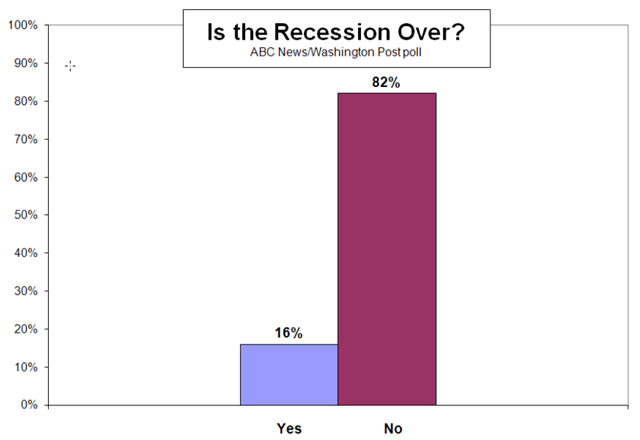
Economists vs Everyone Else
23 Oct 2009From an ABC/WashingtonPost survey.


What is Chart Porn?
An addictive collection of beautiful charts, graphs, maps, and interactive data visualization toys -- on topics from around the world.
Categories
- Bailout (118)
- Chartporn Related (3)
- Commentary (21)
- Culture (669)
- Emerging Markets (66)
- Employment (245)
- Environment/weather (133)
- Finance (298)
- Food (92)
- Global Economy (373)
- Graphic Design (bad) (26)
- Graphic Design (general) (183)
- Graphic Tools (23)
- History (158)
- Housing (162)
- Humor (204)
- Innovative (183)
- Interactive (545)
- Internet/tech (97)
- Maps (578)
- News Media (34)
- Politics (329)
- Reference (97)
- Science (331)
- Source: Economist (101)
- Source: FT (92)
- Source: NYT (147)
- Source: Ritholtz (76)
- Source: USA Today (27)
- Source: Washington Post (90)
- Source: WSJ (135)
- Sports (58)
- Stock Market (74)
- Uncategorized (2)
- Updated regularly (76)
- US Economy (553)
- Video (22)
- Aram Korevaar: This chart is now being used as a projection in which countries such as China see themselves as in a [...]
- David: Welcome back Chart Porn! [...]
- J S: Thanks for the great story. Miss reading this blog. Hope to see you more active again. [...]
- jake: I lived in a DC row house for 6 years, and I'm writing this comment from my tiny 1 bedroom apartment [...]
- ronny pettersen: Hilarious and unfortunately accurate... ;-) [...]