
House Prices to Income
In: Housing US Economy
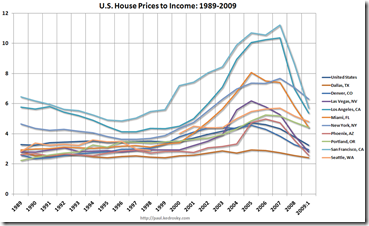
13 Jan 2010The following chart shows the ratio of U.S. housing prices to income for various major cities from 1989-2009. If we say bubbles exists in cities where that ratio is more than two standard deviations outside its long-run average, we still have residential real estate bubbles in Seattle, Portland, New York and Miami. On the other hand, bubble condition no longer exist in Dallas, Denver, Las Vegas, Los Angeles, Phoenix and San Francisco (!).

History Shots
12 Jan 2010History Shots has a number of beautiful classically designed infographics that are very much worth browsing (and/or putting up on your wall).
Conquest of Everest: the expeditions leading up to the successful 1953 assault.

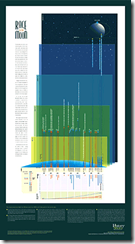
Race to the Moon:
History of the Political Parties:
1992-2008

1730-1982

Genealogy of Pop/Rock Music:

History of the Union and Confederate Armies:


Supreme Court History
12 Jan 2010Comprehensive visualization of the US Supreme Court. It works best as an office poster, obviously – and can be purchased that way for your lawyer friends. It’s the first project from TimePlots – I look forward to more good things from them in the future

Auto Charts
12 Jan 2010The UNEP GEO Data Portal has recently automated some chart production with a custom Illustrator script, for cross-country comparison purposes. The below example is for total CO2 emissions vs per capita. While I really like the waveform-type display aesthetically, I’m not sure of it’s analytical value compared to a bar chart.
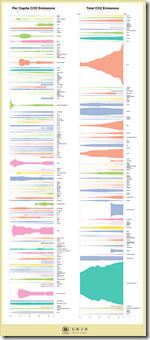
It works a little better here (Total Final Energy Consumption):

Circadian Rhythms
In: Science
12 Jan 2010

The New Job Market
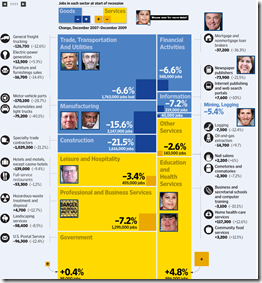
12 Jan 2010From the WSJ, a treemap of the changing US job market (2007-09), with anecdotal popups. Related article.
Freedom Still in Decline
12 Jan 2010Based on Freedom House’s 2010 survey.

Caffeine Delivery Vehicles
11 Jan 2010I don’t think most people realize that coffee usually has more than twice the caffeine of a Red Bull.

As much as I dislike pie charts, I like the simple information here and the popup detail mediates somewhat the radial perception issues.

Netflix Map
10 Jan 2010Most rented and least rented movies in major metro areas. Roll over to view details by zipcode. Clearly contains some errors though. Benjamin Button was No1 and True Blood season 1 was 47? Thanks to Jack Lucky for pointing it out.

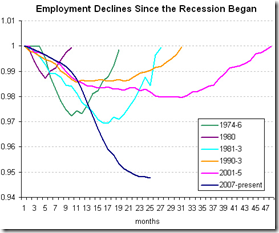
Recession Unemployment
9 Jan 2010Something different is going on.
2010 House Elections
8 Jan 2010The infamous election maps begin to spawn… This one includes fairly detailed analysis of the close races.

Major Trends and Events 1750-2100
In: Culture Global Economy History Politics Reference Science
8 Jan 2010Would make a good poster. Some of the predictions are questionable, of course. (via)

Infographic Resumes
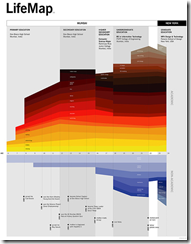
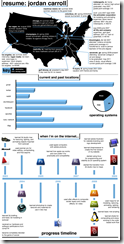
8 Jan 2010Cool Infographics has culled together 16 examples of using infographics as resumes/life timelines. Below are a few of the nicer looking ones, but I recommend reading Randy’s whole article.




What is Chart Porn?
An addictive collection of beautiful charts, graphs, maps, and interactive data visualization toys -- on topics from around the world.
Categories
- Bailout (118)
- Chartporn Related (3)
- Commentary (21)
- Culture (669)
- Emerging Markets (66)
- Employment (245)
- Environment/weather (133)
- Finance (298)
- Food (92)
- Global Economy (373)
- Graphic Design (bad) (26)
- Graphic Design (general) (183)
- Graphic Tools (23)
- History (158)
- Housing (162)
- Humor (204)
- Innovative (183)
- Interactive (545)
- Internet/tech (97)
- Maps (578)
- News Media (34)
- Politics (329)
- Reference (97)
- Science (331)
- Source: Economist (101)
- Source: FT (92)
- Source: NYT (147)
- Source: Ritholtz (76)
- Source: USA Today (27)
- Source: Washington Post (90)
- Source: WSJ (135)
- Sports (58)
- Stock Market (74)
- Uncategorized (2)
- Updated regularly (76)
- US Economy (553)
- Video (22)
- Aram Korevaar: This chart is now being used as a projection in which countries such as China see themselves as in a [...]
- David: Welcome back Chart Porn! [...]
- J S: Thanks for the great story. Miss reading this blog. Hope to see you more active again. [...]
- jake: I lived in a DC row house for 6 years, and I'm writing this comment from my tiny 1 bedroom apartment [...]
- ronny pettersen: Hilarious and unfortunately accurate... ;-) [...]