
Source: WSJ Archive:
Flu Tracker
In: Maps Science Source: WSJ
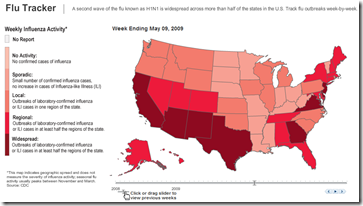
8 Oct 2009There are a lot of these maps out there. This one is interesting because the historical week-by-week animation illustrates the seasonality of the outbreak.
Historical Unemployment (updated)
5 Oct 2009Updated Oct. 09.

Historical Unemployment
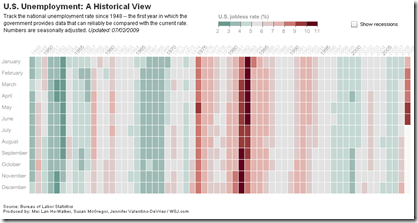
2 Oct 2009A nice change from the usual line chart, from the WSJ.
Not News to Anyone…
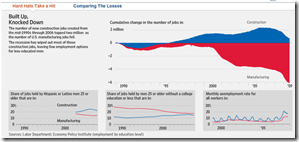
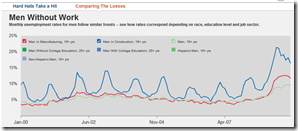
21 Sep 2009Two employment graphics from the WSJ:
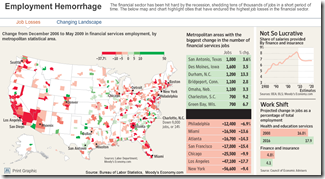
Financial sector job losses (more spread out than I would have suspected). Related article.
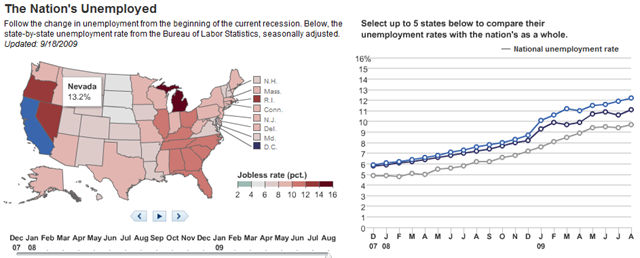
State-by-State, with a timeline slider Dec 07 through August.
Crisis Timeline
16 Sep 2009Call up monthly slivers of data and related news for 6 financial market indicators (dow, treasury yields, libor, commercial yields, CDS spreads, mortgage backed spreads).

Income Equalizing?
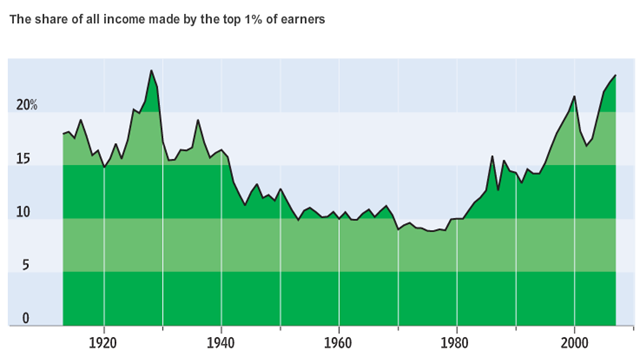
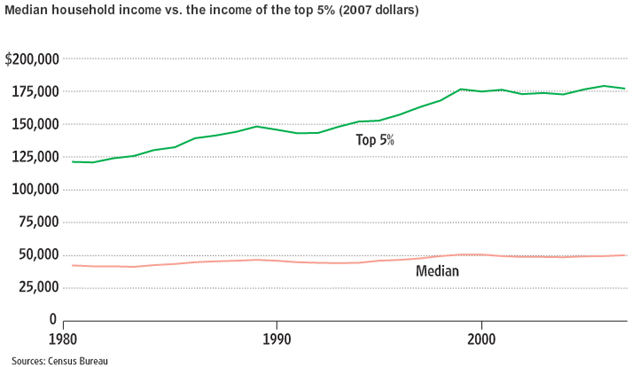
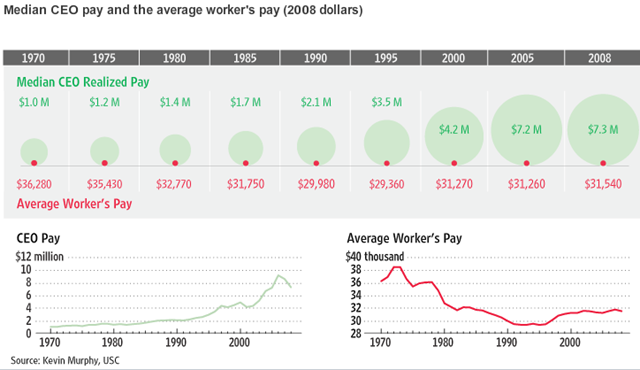
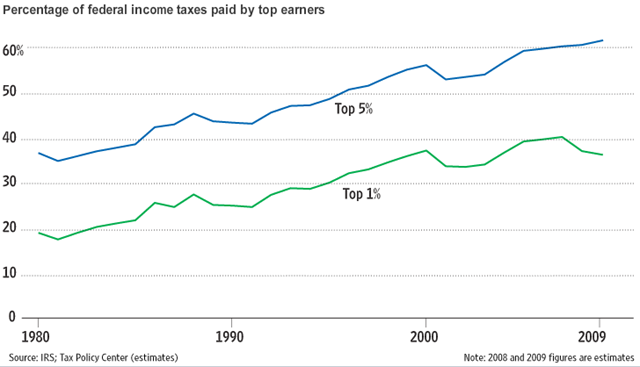
10 Sep 2009Four charts on income inequality in the United States. The related article argues that the recession may be lowering the gap by clobbering the wealthy.
Housing: The United States vs Vermont
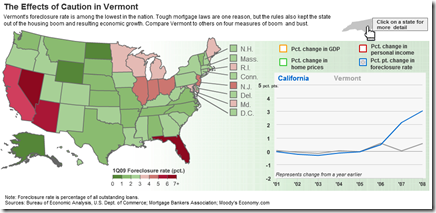
21 Aug 2009Compare some interesting housing variables (foreclosure rate, home price %change, personal income %change, and GDP). The related article talks about Vermont missing the boom and the bust.
Hurricane Season 2009
In: Environment/weather Interactive Maps Science Source: WSJ Updated regularly
21 Aug 2009A map of the paths of several hurricanes. Looks like they plan to update it throughout the hurricane season. This is very similar to the AP tool I mentioned in June.

Foreclosure Breakdown
21 Aug 2009Excellent data from the WSJ, via The Big Picture.

European GDP
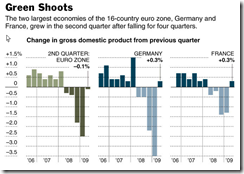
16 Aug 2009Interactive bar chart of EU country GDP. Unfortunately, they resize the scale on every chart, making it tough to do cross-country comparisons (though they do put the euro-zone average on each chart).

From the NYT:
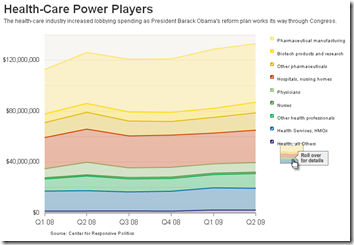
Unhealthy Lobbying
6 Aug 2009Another presentation of data on lobbying from the health-care industry. The roll-overs almost save this from being a pointless chart (it needs a much longer time period).
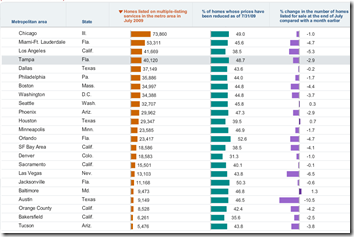
Home Available for Sale
6 Aug 2009Two parts from the WSJ on home listings in major cities. First tab: bar charts showing number of homes for sale, percent who have reduced price, and change month-to-month.
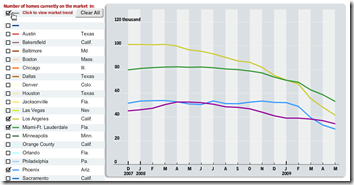
Second tab: Line chart of inventories over the past 18 months.
Housing Volume by Size
3 Aug 2009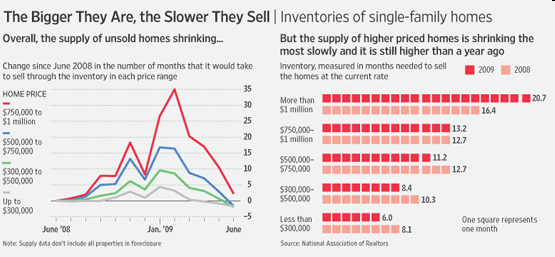


What is Chart Porn?
An addictive collection of beautiful charts, graphs, maps, and interactive data visualization toys -- on topics from around the world.
Categories
- Bailout (118)
- Chartporn Related (3)
- Commentary (21)
- Culture (669)
- Emerging Markets (66)
- Employment (245)
- Environment/weather (133)
- Finance (298)
- Food (92)
- Global Economy (373)
- Graphic Design (bad) (26)
- Graphic Design (general) (183)
- Graphic Tools (23)
- History (158)
- Housing (162)
- Humor (204)
- Innovative (183)
- Interactive (545)
- Internet/tech (97)
- Maps (578)
- News Media (34)
- Politics (329)
- Reference (97)
- Science (331)
- Source: Economist (101)
- Source: FT (92)
- Source: NYT (147)
- Source: Ritholtz (76)
- Source: USA Today (27)
- Source: Washington Post (90)
- Source: WSJ (135)
- Sports (58)
- Stock Market (74)
- Uncategorized (2)
- Updated regularly (76)
- US Economy (553)
- Video (22)
- Aram Korevaar: This chart is now being used as a projection in which countries such as China see themselves as in a [...]
- David: Welcome back Chart Porn! [...]
- J S: Thanks for the great story. Miss reading this blog. Hope to see you more active again. [...]
- jake: I lived in a DC row house for 6 years, and I'm writing this comment from my tiny 1 bedroom apartment [...]
- ronny pettersen: Hilarious and unfortunately accurate... ;-) [...]
Blame the Smart People?
In: Bailout Commentary Finance Humor Source: WSJ US Economy
18 Oct 2009A WSJ op-ed that presents a convincing argument that we can’t blame stupid people for the financial crisis (though they certainly helped).