
Science Archive:
Death by “Natural Causes”
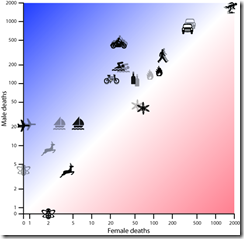
5 Nov 2009Stats on animal related deaths, with some odd first-person descriptions. (via fancystats)

Death Rates
In: Culture Innovative Science
2 Nov 2009I like the shading of 2007 vs 2008 data. Note: I think this is just UK data.
Visualizing Size
In: Innovative Science
30 Oct 2009A very cool and well designed zoomable comparison of relative microscopic sizes. I particularly like the variable scale in the corner. (via FlowingData and Information Aesthetics)

Global Life and Death
29 Oct 2009A data packed international comparison of health statistics. I give Good a lot of grief for the design of some of their infographics, but this one is well done. (via Simple Complexity)

World Opinions on Climate Change
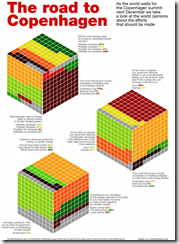
29 Oct 2009An interesting use of 3d cubes to display polling results. The polling questions are also much better constructed than the usual “do you think climate change is happening?”
Swine Flu Mortality
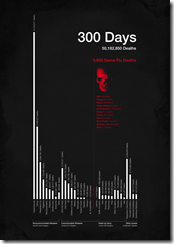
28 Oct 2009This comparison of H1N1 deaths to other causes should help us keep our perspective (of course, you should also consider deaths among certain risk groups).
Before and After Humans
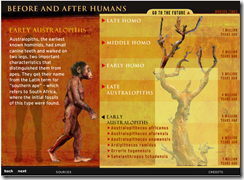
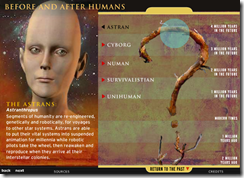
27 Oct 2009This is part informative and part just plain weird. The informative part is that you can click through the past 7 million years of the human evolutionary tree and view summaries of basic characteristics. The weird part is that it also allows you to click through the next 4 million years and see summaries of how we’re going to mess ourselves up. Apparently this is part of MSNBC’s “Fast Forward: The Future of Evolution” feature.
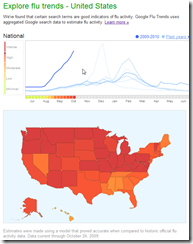
Google Flu Trends
In: Interactive Maps Science
25 Oct 2009Google uses aggregated google search data to estimate flu activity around the world (for 21 countries at the moment).
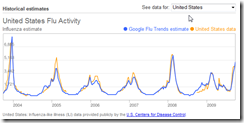
Do you doubt the accuracy of this method? There’s a chart comparing historical CDC reports to the google method:
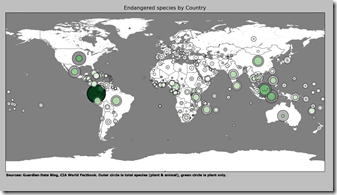
Endangered Species Map
25 Oct 2009The data is only disaggregated at the country level, but it’s still interesting.
Why You Have a Nose
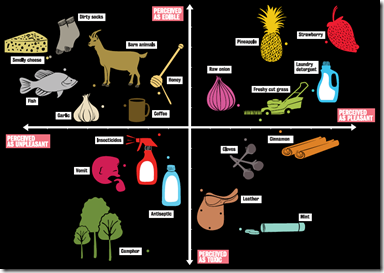
23 Oct 2009There are two evolutionary reasons for having a nose, runs one theory. The first is to ascertain whether it would be safe to put something in your mouth – to gauge edibility. The second is to advise about whether it would be a good idea to run away
Hidden Content
21 Oct 2009I’m starting to think that Good must be TRYING to design these so poorly. I suppose it’s one way to get us to notice the data (since we have to hunt around for it). I’ll leave it to JunkCharts or someone else to enumerate the number of ways this is bad.

Human Transportation
20 Oct 2009Similar in concept to the US McDonalds map, this map colors how long it takes to get to a city of 50,000 people from any location in the world. (via Simple Complexity & Visual Complexity)

the same New Scientist gallery has a map of roads, trains, shipping lanes, and navigable rivers (we’re pretty much everywhere).


DC Tunnels
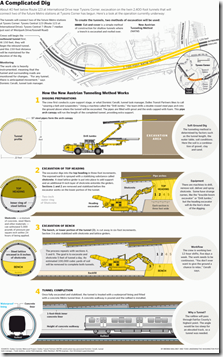
19 Oct 2009Infographic of how the new portions of DC’s metro will be built. Related article. (via KelsoCartography)
Environmental Trends and Basic Data
18 Oct 2009I like this one because it uses colors to represent trends, which is nice when you are trying to display indicators that are on completely different scales.

The same site, the United Nations Environment Programme, has a number of great environment-related infographics:


Blog Action Day 2009: Climate Change
15 Oct 2009
In honor of today being 2009’s Blog Action Day, I present below a series of recent climate change visualizations:
First up, “Kyoto: Who’s on Target”, which uses interesting nested circles for indicators of compliance. (via)

From the Washington Post, an interactive view of carbon emissions from G20 countries (either total or per capita) with a slider to move from 1950 through 2006. Easily missed, you can also click on a countries name on a list below that bubble chart (or on the “country profile” tab) to drilldown to individual countries. The October 5 part of the “special report” also contained a nice overview map.


Next, a treemap of cumulative CO2 emissions (1751-2006):

Breathing Earth‘s CO2 emissions simulator:

another interactive CO2 emissions map:

and if you doubt what effects CO2 levels are having, and whether global warming is something to worry about, please go read the “Global Climate Change Impacts in the United States” report.


or take a look at the Climate Orb, which is gathering stories of environmental impacts around the globe:


What is Chart Porn?
An addictive collection of beautiful charts, graphs, maps, and interactive data visualization toys -- on topics from around the world.
Categories
- Bailout (118)
- Chartporn Related (3)
- Commentary (21)
- Culture (669)
- Emerging Markets (66)
- Employment (245)
- Environment/weather (133)
- Finance (298)
- Food (92)
- Global Economy (373)
- Graphic Design (bad) (26)
- Graphic Design (general) (183)
- Graphic Tools (23)
- History (158)
- Housing (162)
- Humor (204)
- Innovative (183)
- Interactive (545)
- Internet/tech (97)
- Maps (578)
- News Media (34)
- Politics (329)
- Reference (97)
- Science (331)
- Source: Economist (101)
- Source: FT (92)
- Source: NYT (147)
- Source: Ritholtz (76)
- Source: USA Today (27)
- Source: Washington Post (90)
- Source: WSJ (135)
- Sports (58)
- Stock Market (74)
- Uncategorized (2)
- Updated regularly (76)
- US Economy (553)
- Video (22)
- Aram Korevaar: This chart is now being used as a projection in which countries such as China see themselves as in a [...]
- David: Welcome back Chart Porn! [...]
- J S: Thanks for the great story. Miss reading this blog. Hope to see you more active again. [...]
- jake: I lived in a DC row house for 6 years, and I'm writing this comment from my tiny 1 bedroom apartment [...]
- ronny pettersen: Hilarious and unfortunately accurate... ;-) [...]