
Interactive Archive:
Atomic Atlas
17 Mar 2011The FT has created two maps of the world’s nuclear power plants. The first is a fairly comprehensive collection of information on distribution, types, and history:

The second is an interactive googlemaps-based version which locates operating, under construction, planned, and shut down plants. (related article)

College Degrees (1940-2009)
12 Mar 2011An interactive map of adults with college degrees. Filter by race or income or drill down to your county. I’m not sure if it’s more surprising that it went from 4.6% to 27.5%, or that we’re only at 27.5% today. How long do you suppose before someone puts this next to a red/blue state map? (via Sociological Images)
1940 vs 2009:


Where are the Happiest People in America?
7 Mar 2011Gallup surveyed Americans on 20 different quality of life indicators (stress, depression, health problems, job satisfaction, exercise, etc), and the New York Times threw them all on a map for contemplation. Below is the composite “Well-Being index”. Thanks to Allison Stanfill for the link! (related article)

Gallup’s website compares the indicators over time:

A similar Gallup index of “US Satisfaction” was also recently visualized by Good:

MBA Student Mobility
25 Feb 2011The Financial Times surveyed 5000+ alumni from the top 50 MBA programs in the world and mapped out where they came from, where they went to school, and where they ended up. It’s slightly confusing at first, because they do not map all of the students at once – it shows only one country of origin at a time. Still, it’s very cool if you pay attention to where the dots flow when you change categories. (related article)

note: access to some FT features requires a subscription.
Google and Eyebeam have created a $10,000 dataviz challenge for designers to visualize how individual federal income taxes are spent. The site includes details, data, and a few cool examples, like the one below that lets you input your income and see how the government shelled out your shekels. Submissions are due by March 27, 2011. (Thanks to Melissa Mac for the link!)

An inspirational British version:

and a excellent interactive chart one that let’s you examine the changing income inequality in the united states (and probably the only good use I’ve seen of a pie chart in a long time):

Inflation: The Details
18 Feb 2011Sure, inflation in January was only 1.6%:

but there’s a lot of variation in the products that make up the CPI (butter was up 19.6% y-y, for example), which this tool from the WSJ lets you explore:

Want to know how the CPI weights all of these goods? Check out this oldie but goodie:

US Budget 1981-2012
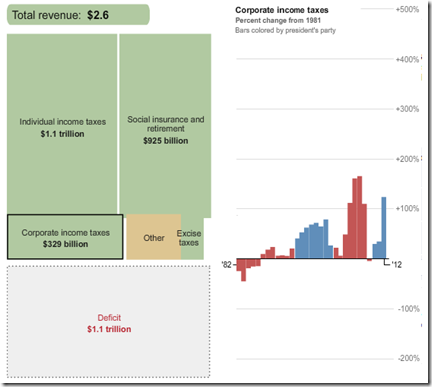
15 Feb 2011Here are some interactive tools to let you explore the President’s recent budget proposal, where that money comes from, and where it goes. First, from the Washington Post, a look at 30 years of budgets: Revenue is on the left, expenses on the right; click on any box to see the percentage change since 1981; bars are colored by the president’s party.
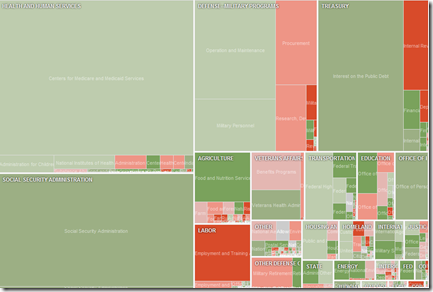
Next, a more detailed treemap from the NYT, but only covering the 2012 values and change from 2010.
Cost of Renting vs Owning
In: Housing Interactive Maps
14 Feb 2011Real estate listing service Trulia has created this interactive map of median rental costs vs purchase prices on a two bedroom home. In case you are thinking of moving, they also supply bar charts of unemployment, foreclosure, and job growth for the same cities.


The data is updated each quarter and supplemented with a series of simpler infographics:


Muni Market Woes
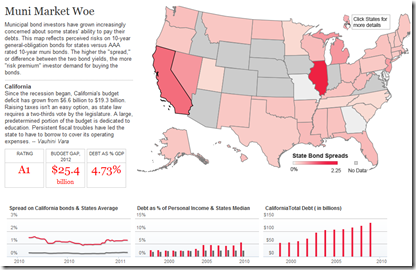
10 Feb 2011There’s a lot of attention on the national debt, but states are in even deeper trouble. In part because investors don’t trust them to get their act together, resulting in lower ratings and higher borrowing costs. The below clickable map lets you view debt levels and interest rate spreads by state.
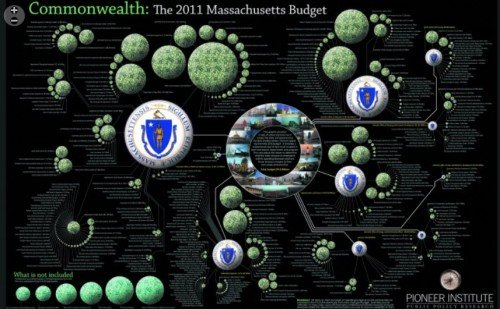
And while we’re talking about state fiscal policies, here’s a beautiful representation of the Massachusetts 2011 budget:
The Organized Crime Network
7 Feb 2011Just how organized is organized crime? Think of it as the world’s largest and most illicit social network.
Ok, that may not be the best analogy ever, but this interactive map of transnational crime with popup details is a fascinating way to explore the $2 trillion global grey market of illegal activity. (via Ritholtz)


Global Debt (1880-2009)
In: Finance Global Economy History Interactive Maps Politics
7 Feb 2011The IMF has released a new database of sovereign debt-to-gdp ratios for 174 countries, going back as far as 1880 (for G7 countries).
The data shows how government debt has risen and fallen over the years as important events, such as wars and stock market crashes, affect a country’s decisions about when to save and when to spend. It turns out the relationship between debt and economic growth has changed over time; historically, fast growing countries had low debt ratios, while slow growers struggled under higher debt. In the past 30 years that relationship has altered as advanced economies’ debt levels have risen and their economies have grown.The data also debunks some old clichés, for example that African countries have the highest debt levels. In fact, low income countries in Africa today have lower debt ratios than do advanced economies in Europe and North America.
The below charts appear in a slightly slow, but interesting, IMF You-tube video:


The data can also be explored and exported using the IMF’s DataMapper (note the links at the bottom of the mapper to the related working paper and dataset):

Where the Streets Have Your Name
In: Culture Interactive Maps
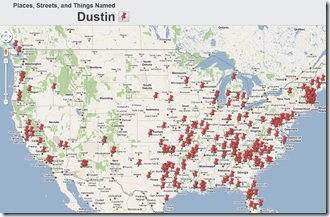
7 Feb 2011Stephen von Worley tracked down streets, places, and things all across the the world that use one of over 10,000 first names. Just enter your name and click on a pushpin to go to that location in either Google Maps or Google Earth. You can even use street view to see the signs and streets themselves. I can’t help but see this leading to a sign-theft crime spree. 😉

The Best Companies to Work For
4 Feb 2011Fortune surveyed employees of 211 companies about management credibility, job satisfaction, and camaraderie, then combined that with information on pay, benefits, and management practices to rank the best companies to work for. The below interactive word cloud allows you to drill down through the words employees used the most to describe their companies.

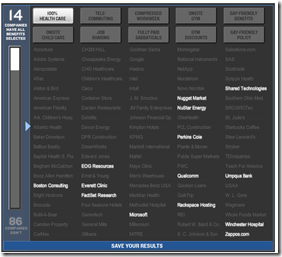
You can also see who pays the most, and who has the best perks (explorable using the below perk-finder):
The World is Getting Fat(ter)
4 Feb 2011Male and female body mass indices by country, from 1980-2008. Some interesting, but perhaps not surprising, observations: European men are consistently fatter than the women, poor people are skinny, and everyone has gotten fatter over the past 18 years. (related article)

Flags of the World
In: Interactive Maps Reference
2 Feb 2011Roll over any nation on this map of the world to see that country’s flag, as well as an explanation of the symbolism of its design. For example, the colors in Egypt’s flag represent oppression (black), overcome through bloody struggle (red), to be replaced by a bright future (white) – a timeless design, apparently. Thanks to Jack Lucky for the link!


What is Chart Porn?
An addictive collection of beautiful charts, graphs, maps, and interactive data visualization toys -- on topics from around the world.
Categories
- Bailout (118)
- Chartporn Related (3)
- Commentary (21)
- Culture (669)
- Emerging Markets (66)
- Employment (245)
- Environment/weather (133)
- Finance (298)
- Food (92)
- Global Economy (373)
- Graphic Design (bad) (26)
- Graphic Design (general) (183)
- Graphic Tools (23)
- History (158)
- Housing (162)
- Humor (204)
- Innovative (183)
- Interactive (545)
- Internet/tech (97)
- Maps (578)
- News Media (34)
- Politics (329)
- Reference (97)
- Science (331)
- Source: Economist (101)
- Source: FT (92)
- Source: NYT (147)
- Source: Ritholtz (76)
- Source: USA Today (27)
- Source: Washington Post (90)
- Source: WSJ (135)
- Sports (58)
- Stock Market (74)
- Uncategorized (2)
- Updated regularly (76)
- US Economy (553)
- Video (22)
- Aram Korevaar: This chart is now being used as a projection in which countries such as China see themselves as in a [...]
- David: Welcome back Chart Porn! [...]
- J S: Thanks for the great story. Miss reading this blog. Hope to see you more active again. [...]
- jake: I lived in a DC row house for 6 years, and I'm writing this comment from my tiny 1 bedroom apartment [...]
- ronny pettersen: Hilarious and unfortunately accurate... ;-) [...]