
Interactive Archive:
Unemployment (1948-2011)
In: Employment Interactive Source: WSJ Updated regularly US Economy
14 Nov 2011I haven’t posted this version in a while, but the WSJ does keep it up to date with the latest data. I think it’s a lovely use of a heatmap.

Sexperience
13 Nov 2011Based on a survey of 1000 British adults, this interactive display lets you select questions and filter answers in a variety of interesting charts, where each dot represents a person in the survey. The live animations are really cool, though some of the presentations are more effective than others.

Atlas of Economic Complexity
8 Nov 2011Harvard has released an interesting new index of “economic complexity” which is the productive knowledge of the economy, based on analysis of its output composition.
… the Economic Complexity Index (ECI) is based on the number and the complexity of the products that a country exports with comparative advantage. Empirically, countries that do well in this index, given their income level, tend to achieve higher levels of economic growth. The ability to successfully export new products is a reflection of the fact that the country has acquired new productive knowledge that will then open up further opportunities for progress.
The index is then used to make detailed growth projections, and identify export opportunities on a country-by-country basis.


There are also interactive versions of most of these visualizations that you can explore and filter:

(via)
Evolution of Western Dance Music
In: Culture Interactive Maps
2 Nov 2011An interactive timeline showing (roughly) the origins and evolution of different genres of dance music. I wish you could filter to see the connections a little clearer.

The Road to 7 Billion
27 Oct 2011The Financial Times has pulled together some interactive visualizations of world demographics as we approach 7 billion people. I would have liked to see the population pyramids for more countries. The fertility/education graph is a bit shocking.


Note: Some FT features require a subscription.
Shoe Throwing Index
24 Oct 2011This is a strange little tool: an interactive index to middle east unrest.
Move the sliders to ascribe different weightings to the various indicators that may influence instability (since the values shown are rounded, they may not always add up to exactly 100). Lock individual sliders by clicking the checkboxes. Roll over the chart to see indicators for each country.

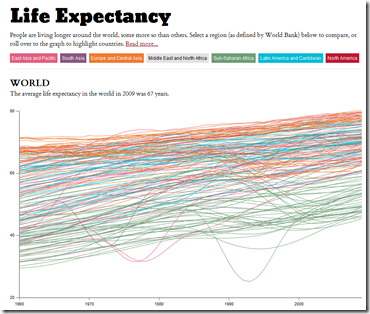
Life Expectancy (1960-2009)
15 Oct 2011Highlight by region, roll over for individual country info. The interface is a little janky – you can join the discussion over at FlowingData if you have any suggestions.
Washington DC Housing Prices
11 Oct 2011A nicely annotated analysis of changing house prices in the DC region. The main graphic shows how much you would need to earn to buy a “typical single family home”. There is also an interactive version which lets you compare information for different time periods and look at condo vs house sales. (related article)


US State Budget Gaps
In: Finance Interactive Internet/tech Politics Source: FT US Economy
27 Sep 2011What is shocking to me is that there are 12 states with no shortfall.

Note: Some Financial Times features require a subscription.
Weather and Conception
26 Sep 2011Statistics indicate that more people are born in the fall (in the USA anyway), with the quick explanation being that we have more sex during the winter holidays (9 months earlier). GE takes a cut at this notion by comparing average temperatures and deviations from the national average birthrate. Statistically, however, using annual data adds enough noise in my mind to make drawing conclusions kind of tough. Anyone want to dig up the monthly data (even for one state) and do a lagged scatter plot? Hmmmm… how would you seasonally adjust this data?
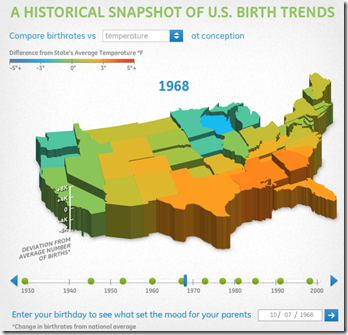
(one minor complaint: the 3d scale is interesting for comparing states, but you can’t tell what the values are for any of them because of the angle)
Tax Break Breakdown
In: Innovative Interactive Politics Source: Washington Post US Economy
19 Sep 2011To be cliché: the truth may surprise you. This is a great look at the “loopholes” in our tax system, point by point. You can filter by kind of break, compare individual vs corporate, find out when they were first implemented, and see how they all add up. However, I really wish the lines in the main bar graph had matched width with the amount of the break (with the y-axis being billions of $) – at first glance that’s what I thought was going on. I’m also not sure how I feel about things like “employer contributions to health care” being considered a break. (related article)

Newspapers (1690-2011)
16 Sep 2011Much like the post office timeline movie I posted last month, below we have the history of newspaper expansion across the USA. Interestingly, this movie is actually an extraction from a very well done interactive visualization of the Library of Congress’s newspaper database. You can even drill down to individual towns and see information about each newspaper. (via)
Original interactive version: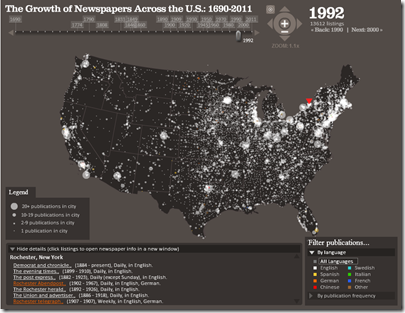
Capital Inflows
In: Emerging Markets Finance Global Economy Interactive Maps Source: WSJ
15 Sep 2011Cheap money and slow growth in the advanced countries has led to large capital flows to emerging market countries, as this interactive tool from the WSJ shows. If you mouse over each country you can view countries’ policy responses. I really like these map/graph combo designs – the two go very well together.

How Healthy is Your Bank?
13 Sep 2011From MSNBC and the American University: Identify your bank (or credit union) by name or location, then see how many non-performing loans and other troubled assets it has:


of related interest is this 2010 chart that Barry Ritholtz recently noted:

The Cost of 9/11
11 Sep 2011NYT presents a graphical breakdown of some cost estimates for 9/11:

You can drill down into the different categories:


What is Chart Porn?
An addictive collection of beautiful charts, graphs, maps, and interactive data visualization toys -- on topics from around the world.
Categories
- Bailout (118)
- Chartporn Related (3)
- Commentary (21)
- Culture (669)
- Emerging Markets (66)
- Employment (245)
- Environment/weather (133)
- Finance (298)
- Food (92)
- Global Economy (373)
- Graphic Design (bad) (26)
- Graphic Design (general) (183)
- Graphic Tools (23)
- History (158)
- Housing (162)
- Humor (204)
- Innovative (183)
- Interactive (545)
- Internet/tech (97)
- Maps (578)
- News Media (34)
- Politics (329)
- Reference (97)
- Science (331)
- Source: Economist (101)
- Source: FT (92)
- Source: NYT (147)
- Source: Ritholtz (76)
- Source: USA Today (27)
- Source: Washington Post (90)
- Source: WSJ (135)
- Sports (58)
- Stock Market (74)
- Uncategorized (2)
- Updated regularly (76)
- US Economy (553)
- Video (22)
- Aram Korevaar: This chart is now being used as a projection in which countries such as China see themselves as in a [...]
- David: Welcome back Chart Porn! [...]
- J S: Thanks for the great story. Miss reading this blog. Hope to see you more active again. [...]
- jake: I lived in a DC row house for 6 years, and I'm writing this comment from my tiny 1 bedroom apartment [...]
- ronny pettersen: Hilarious and unfortunately accurate... ;-) [...]