
Interactive Archive:
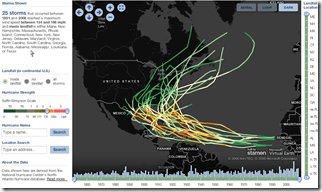
Hurricane Tracker
8 Nov 2009Another historical look at hurricanes. This one has a number of very interesting filters and sliders. I wish someone would do something like this for recessions (not on a map, obviously). (via Vizworld)
Wine Wheel
In: Culture Interactive
5 Nov 2009An attempt to categorize types of wine by aroma, sensation, flavor, and “characteristic”.

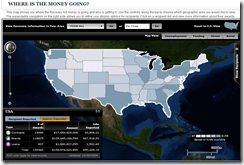
Recovery Mapping
5 Nov 2009Recovery.org has an interactive map that lets you track where the spending is going (down to the street level).
AP Economic Stress Map (November update)
In: Employment Finance Housing Interactive Maps Updated regularly US Economy
2 Nov 2009Updated November 2nd. The map displays unemployment, foreclosures, bankruptcy, or a composite “stress index”, by county. In the upper right you can change the period the %-change is calculated for. To look at data over time, click on the “Oct.2007 to present” option and a historical slider will appear at the bottomDouble click on a region to zoom in; click & hold to move around.

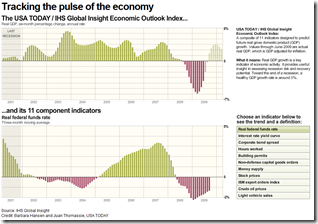
USA Today Economic Outlook Index (October edition)
In: Employment Finance Housing Interactive Stock Market US Economy
2 Nov 2009Updated October 28th. The best part is the lower chart showing the latest data for each of the 11 “leading indicators”.
Draw Your Accident
2 Nov 2009It’s a bit off-topic, but I like this niche little online tool for mapping out the scene of your own automobile accident.

Timeline of recession and recovery (the Adversity Index) from Moodys/MSNBC (1995-2009). You can drill down to individual metro areas by clicking on a state. The Adversity Index page has a number of related articles.

There’s also a map of “recession resistant areas” (has had no more than 9 months of recession over the past 15 years).

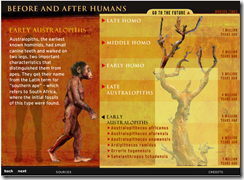
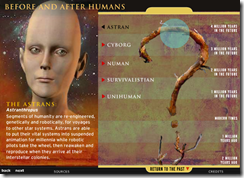
Before and After Humans
27 Oct 2009This is part informative and part just plain weird. The informative part is that you can click through the past 7 million years of the human evolutionary tree and view summaries of basic characteristics. The weird part is that it also allows you to click through the next 4 million years and see summaries of how we’re going to mess ourselves up. Apparently this is part of MSNBC’s “Fast Forward: The Future of Evolution” feature.
Obama Tracker
26 Oct 2009An odd little tool – it’s a timeline of major economic, domestic policy, and foreign policy events and developments. It’s not clear to me what use the bars are. Perhaps a calendar would have been better?

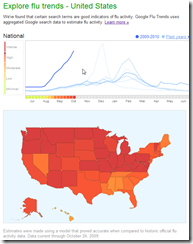
Google Flu Trends
In: Interactive Maps Science
25 Oct 2009Google uses aggregated google search data to estimate flu activity around the world (for 21 countries at the moment).
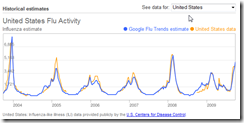
Do you doubt the accuracy of this method? There’s a chart comparing historical CDC reports to the google method:
2008 Executive Compensation
In: Bailout Finance Interactive Source: USA Today US Economy
23 Oct 2009Interactive table. Select an industry, sort by any column.

BBC G20
In: Bailout Emerging Markets Finance Global Economy Interactive Maps Politics US Economy
19 Oct 2009A bit dated as these were prepared in the lead up to the Pittsburgh summit a few weeks ago. Worth passing on nonetheless.

A checklist of the G20’s April London Summit pledges and whether they’ve been fulfilled. Included some nice graphics on IMF and tax reforms.


G20 Stimulus and Fiscal Deficit map. Use the slider to look at the changes 2007-2010. Mouse over a country to view popup data details.

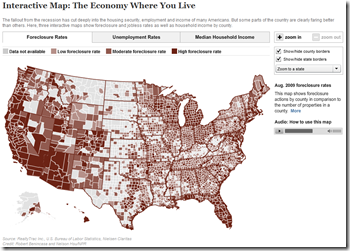
NPR Economy Map
18 Oct 2009Foreclosures, unemployment, and median household income. The scales are a little vague on two of the maps — but it’s ok for broad comparative purposes.
Stimulate Those Jobs
In: Bailout Employment Innovative Interactive Maps Source: USA Today US Economy
16 Oct 2009A funky little interactive map from USA Today. Click on a state on the map and the appropriate little dot on the sorted chart on the right will highlight to show you it’s ranking. When you change the indicator using the drop down box at the top (jobs created/total funds awarded/total funds received/unemployment rate) the dots in the chart all bounce around and resort themselves.

Blog Action Day 2009: Climate Change
15 Oct 2009
In honor of today being 2009’s Blog Action Day, I present below a series of recent climate change visualizations:
First up, “Kyoto: Who’s on Target”, which uses interesting nested circles for indicators of compliance. (via)

From the Washington Post, an interactive view of carbon emissions from G20 countries (either total or per capita) with a slider to move from 1950 through 2006. Easily missed, you can also click on a countries name on a list below that bubble chart (or on the “country profile” tab) to drilldown to individual countries. The October 5 part of the “special report” also contained a nice overview map.


Next, a treemap of cumulative CO2 emissions (1751-2006):

Breathing Earth‘s CO2 emissions simulator:

another interactive CO2 emissions map:

and if you doubt what effects CO2 levels are having, and whether global warming is something to worry about, please go read the “Global Climate Change Impacts in the United States” report.


or take a look at the Climate Orb, which is gathering stories of environmental impacts around the globe:


What is Chart Porn?
An addictive collection of beautiful charts, graphs, maps, and interactive data visualization toys -- on topics from around the world.
Categories
- Bailout (118)
- Chartporn Related (3)
- Commentary (21)
- Culture (669)
- Emerging Markets (66)
- Employment (245)
- Environment/weather (133)
- Finance (298)
- Food (92)
- Global Economy (373)
- Graphic Design (bad) (26)
- Graphic Design (general) (183)
- Graphic Tools (23)
- History (158)
- Housing (162)
- Humor (204)
- Innovative (183)
- Interactive (545)
- Internet/tech (97)
- Maps (578)
- News Media (34)
- Politics (329)
- Reference (97)
- Science (331)
- Source: Economist (101)
- Source: FT (92)
- Source: NYT (147)
- Source: Ritholtz (76)
- Source: USA Today (27)
- Source: Washington Post (90)
- Source: WSJ (135)
- Sports (58)
- Stock Market (74)
- Uncategorized (2)
- Updated regularly (76)
- US Economy (553)
- Video (22)
- Aram Korevaar: This chart is now being used as a projection in which countries such as China see themselves as in a [...]
- David: Welcome back Chart Porn! [...]
- J S: Thanks for the great story. Miss reading this blog. Hope to see you more active again. [...]
- jake: I lived in a DC row house for 6 years, and I'm writing this comment from my tiny 1 bedroom apartment [...]
- ronny pettersen: Hilarious and unfortunately accurate... ;-) [...]