
Interactive Archive:
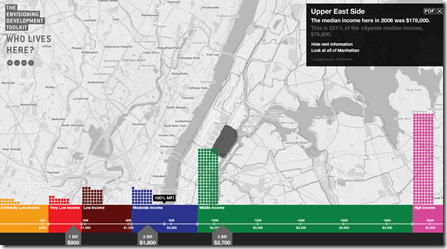
Who Can Afford to Live in NYC?
2 Dec 2009Click on any section of NYC to see the income distribution in that area, and what the average rents are. (via)
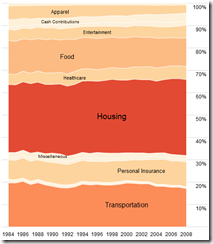
Consumer Spending
2 Dec 2009Click on a category to blow it up. From Flowingdata.
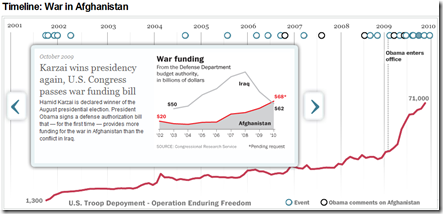
Afghanistan Timeline
2 Dec 2009A nice tool from the Washington Post, includes graphs on troop deployment, war funding, death tolls, and comparisons to other conflicts.
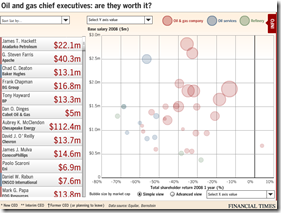
Oil and Gas Executive Pay
1 Dec 2009A fairly detailed analysis of pay vs performance. You can pick from 10 indicators of compensation and 8 indicators of corporate performance. Click on any bubble to popup details of that company and executive. Related article.
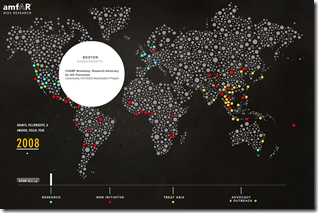
Aids Research
1 Dec 2009Interactive map of the activities of the amfAR organization in 2008.
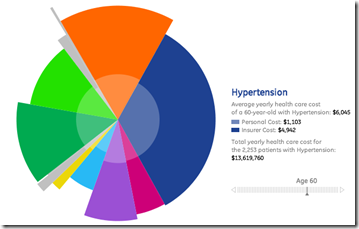
Cost of Getting Sick
23 Nov 2009GE has put together an interactive toy for looking at how expensive different illnesses are at different ages. Use the slider at the bottom to pick the age. “Wedges are colored by chronic condition and wedge size (angle), represents the percentage of patients with the condition. Wedge length from center to edge is cost. The lightly colored portions are personal cost and the darkly colored are insurer cost.” (via FlowingData) Robert Kosara has a detailed critique of the chart over at eagereyes.
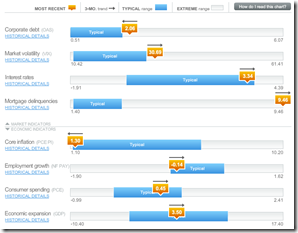
Economic Recovery Dashboard (Nov 09 ver)
In: Employment Finance Global Economy Housing Interactive US Economy
23 Nov 2009November update of one of my favorite summaries of economic indicators. If you normally find this stuff confusing you should check it out – click on any of the “historical details” to see what each indicator means and why it’s important.
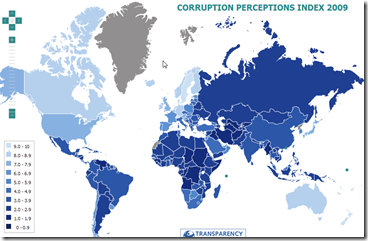
Corruption 2009
20 Nov 2009Interactive map of Transparency International’s 2009 “Corruption Perception Index”. (via)
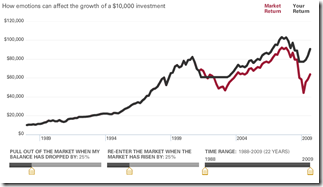
Emotional Investing
19 Nov 2009The second one from Vanguard lets you adjust when you leave and enter the market (based on market crashes/recoveries). Very cool.
Interactive Investing
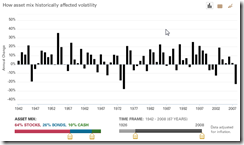
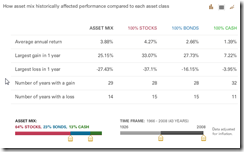
18 Nov 2009Vanguard has several interesting interactive tools for visualizing investment decisions. The first concerns investment composition. Use the sliders at the bottom to choose between stocks, bonds, and cash – and to show how your investments would have performed over any date range since 1928. Click on the little graph icons in the upper right corner to view it as data or a line chart. Thanks to Diane Fitzer for pointing them out.

Europe’s Finance Ministers
16 Nov 2009Interactive ranking of performance on several factors.

Political Map
15 Nov 2009Use the slider to browse the changing political makeup of America, 1960-today.


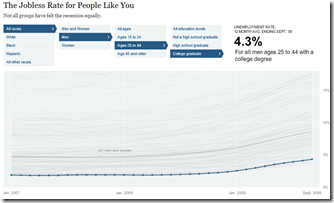
Personalized Unemployment
9 Nov 2009How bad would it be for you if you lost your job? This NYT graphic lets you filter the unemployment statistics on several variables.


What is Chart Porn?
An addictive collection of beautiful charts, graphs, maps, and interactive data visualization toys -- on topics from around the world.
Categories
- Bailout (118)
- Chartporn Related (3)
- Commentary (21)
- Culture (669)
- Emerging Markets (66)
- Employment (245)
- Environment/weather (133)
- Finance (298)
- Food (92)
- Global Economy (373)
- Graphic Design (bad) (26)
- Graphic Design (general) (183)
- Graphic Tools (23)
- History (158)
- Housing (162)
- Humor (204)
- Innovative (183)
- Interactive (545)
- Internet/tech (97)
- Maps (578)
- News Media (34)
- Politics (329)
- Reference (97)
- Science (331)
- Source: Economist (101)
- Source: FT (92)
- Source: NYT (147)
- Source: Ritholtz (76)
- Source: USA Today (27)
- Source: Washington Post (90)
- Source: WSJ (135)
- Sports (58)
- Stock Market (74)
- Uncategorized (2)
- Updated regularly (76)
- US Economy (553)
- Video (22)
- Aram Korevaar: This chart is now being used as a projection in which countries such as China see themselves as in a [...]
- David: Welcome back Chart Porn! [...]
- J S: Thanks for the great story. Miss reading this blog. Hope to see you more active again. [...]
- jake: I lived in a DC row house for 6 years, and I'm writing this comment from my tiny 1 bedroom apartment [...]
- ronny pettersen: Hilarious and unfortunately accurate... ;-) [...]