
Interactive Archive:
Tracking a Toxic Mortgage Security
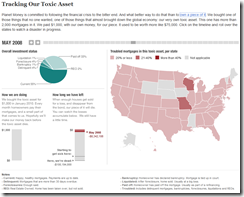
19 Mar 2010A fantastic look at what owning one of these assets looks like. NPR’s Planet Money bought a $1000 mortgage bond and is tracking it’s performance. You can view how many payments they’ve received versus how many properties in their portion of the bond have been sold at a loss. Related article. (via Vizworld)
There’s also a cute simple explanation video:
Global Central Bank Rates (2004-10)
In: Finance Global Economy Interactive Maps Politics Source: WSJ US Economy
18 Mar 2010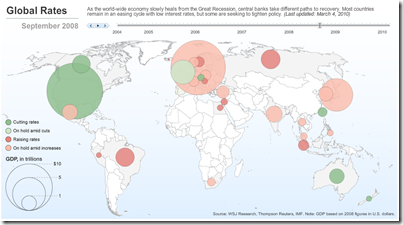
FED Balance Sheet (updated)
18 Mar 2010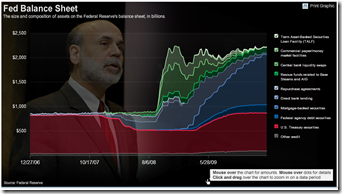
Global Mergers and Acquisitions (2000-09)
18 Mar 2010A particularly useless pie chart, but the map and table are interesting to use with the timeline slider.


2009 News Coverage Filter
16 Mar 2010Pew Research has created an interactive filter of 2009 news coverage that graphs results by media outlet and topic. It’s a little confusing at first, but fun to play with. For example, below, you can compare Fox and NPRs coverage of several issues. Note: I had to disable Firefox’s ad-blocker to view it. (via)

NCAA Brackets
15 Mar 2010There are many others out there, but here are some of the slickest:
Interactive version from the NYT where you can enter and save your picks and compare your results to others over time. 
ESPN’s is kind of nice as you can drag a pick straight through to the final and has popup background info:

The NCAA.com version has a bit of background info on each team in popups:

NBC’s bracket let’s you fill in and print out your picks, provides analysis on each matchup, and has prizes(?).

NYC’s Best Coffee
14 Mar 2010I don’t know what standard they used, but the NYT has mapped out NYC’s “outstanding coffee bars.” (I hate coffee so didn’t bother to read the related article)

Understand Health Reform
In: Interactive Politics
12 Mar 2010A nice interactive tool from the AP that explains the health reform bills, including a “you” filter that explains what provisions will affect you based on your age and current insurance.

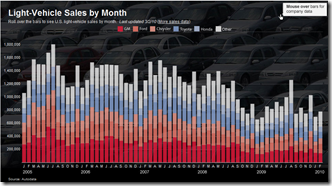
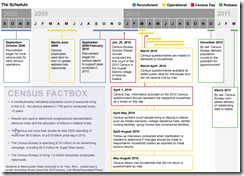
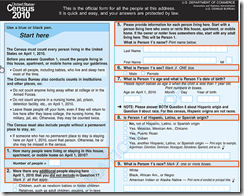
The Census
8 Mar 2010Nice summary from the WSJ: The Summary, the questions, and the results (1880-2000).

Declining Stock Trade Size (99-09)
8 Mar 2010The average size of stock trades has been shrinking in the medium term.

note: if you have trouble seeing the FT grapic try a google search for the article name “Average trade size on top world stock exchanges” and click on the link there.
History of the World in Objects
2 Mar 2010From the BBC. Use the slider on the right to scroll through history, then click on an object to see it’s significance; tons of filters on the left. (via)

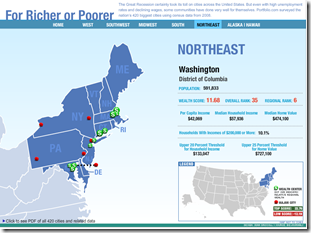
US Wealth Centers
26 Feb 2010Comparison of metropolitan areas by wealth.
The Female Sex Drive
25 Feb 2010More great work from okCupid in the same article “The Case for an Old Woman“. I’m posting it separately because of the great charts.
First up, a map of “Ideally, how often would you have sex?”. (Move the slider to change the age) 
Is contraception morally wrong: 
Sparklines of preferences:

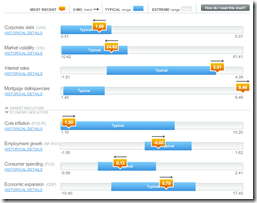
Economic Indicators Dashboard (Feb 10 ver)
23 Feb 2010One of my favorite summaries of economic indicators. Click on any of the “historical details” to see what each indicator means and why it’s important.


What is Chart Porn?
An addictive collection of beautiful charts, graphs, maps, and interactive data visualization toys -- on topics from around the world.
Categories
- Bailout (118)
- Chartporn Related (3)
- Commentary (21)
- Culture (669)
- Emerging Markets (66)
- Employment (245)
- Environment/weather (133)
- Finance (298)
- Food (92)
- Global Economy (373)
- Graphic Design (bad) (26)
- Graphic Design (general) (183)
- Graphic Tools (23)
- History (158)
- Housing (162)
- Humor (204)
- Innovative (183)
- Interactive (545)
- Internet/tech (97)
- Maps (578)
- News Media (34)
- Politics (329)
- Reference (97)
- Science (331)
- Source: Economist (101)
- Source: FT (92)
- Source: NYT (147)
- Source: Ritholtz (76)
- Source: USA Today (27)
- Source: Washington Post (90)
- Source: WSJ (135)
- Sports (58)
- Stock Market (74)
- Uncategorized (2)
- Updated regularly (76)
- US Economy (553)
- Video (22)
- Aram Korevaar: This chart is now being used as a projection in which countries such as China see themselves as in a [...]
- David: Welcome back Chart Porn! [...]
- J S: Thanks for the great story. Miss reading this blog. Hope to see you more active again. [...]
- jake: I lived in a DC row house for 6 years, and I'm writing this comment from my tiny 1 bedroom apartment [...]
- ronny pettersen: Hilarious and unfortunately accurate... ;-) [...]