
Interactive Archive:
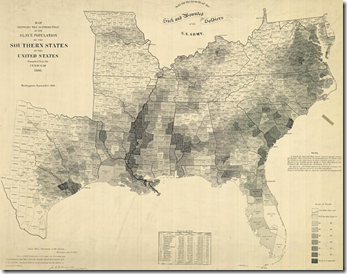
Map of American Slavery:1860
14 Dec 2010Contrary to my expectations, the use of slaves across the pre-civil war South was pretty diverse – as this map and accompanying article in the NYT shows. There is also an interactive version with annotated popups. (via)
Foreclosure Delays (2007-2010)
13 Dec 2010This map timeline shows how the average number of days owners spend in delinquency before being foreclosed on has more than doubled since 2007.

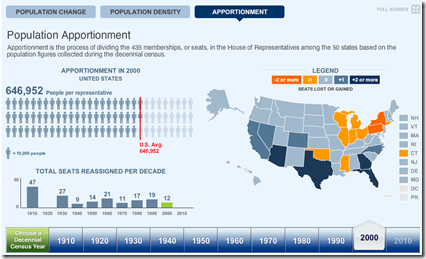
Census Map (1910-2010)
13 Dec 2010The 2010 data isn’t being released until next week, but the Census Bureau has pre-staged a very nice multi-part interactive map displaying state level data and related congressional apportionments from 1910-2010. (thanks to Samantha O’Neil for the link!)
Map of Metal
In: History Interactive Maps
9 Dec 2010A truly impressive interactive map of Heavy Metal music. Scroll through the decades of genres (separated by chains) from the 60s til today. Click on any skull to read a description and hear related tracks. (Thanks to Michael Lewis for the link!)
\m/

America’s Health (1990-2010)
In: Interactive Maps Science
7 Dec 2010A nice interactive exploration of America’s health based on 42 different indicators. One minor complaint: There’s no data for Washington, DC (where I live).

Balance the US Budget
30 Nov 2010Another “You Make the Cuts” interactive, this one from the FT. Set your targets, select your cuts, and then see who is affected.

Note: Some FT features require a subscription.
World Bank Data Visualizer
In: Emerging Markets Global Economy History Interactive Reference
30 Nov 2010Graph a wide range of World Development Indicators, gapminder-style, using the World Bank’s Data Visualizer. There is also a trade-related version.

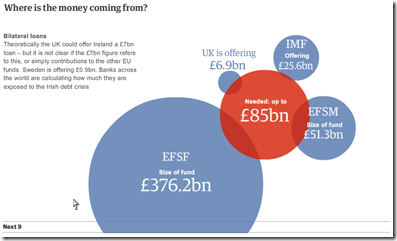
The Ireland Problem
24 Nov 2010How big is it and who is going to come up with the bailout money?

Part of a multi-part Washington Post Investigation. Each dot represents a death; word clouds illustrate information on the circumstances, sentencing, and other details.

American Human Development Index
In: Employment Food Housing Interactive Maps Science US Economy
21 Nov 2010Based on the idea that well-being cannot be measured by GDP alone, the Human Development Index looks at over 100 indicators, which you can explore on maps and charts at the most detailed level, or as aggregates (health, education, income). The chart display does seem to have problems separating out Washington DC, however – since we don’t actually have a congressional district — <sigh>. (via)


Why Get Married?
In: Culture Interactive
18 Nov 2010A recent survey examined changing view and practices on marriage, children, and household composition. This interactive from the Pew Research Center laid it out best:(full poll report)

The below analysis from Time Magazine spells some of the subtler points:


Generation Quiz
15 Nov 2010A series of cultural image quizzes leads to a prediction of when you were born. Interesting in theory – but it missed me by about 10 years.
 ‘
‘

European Banks’ Sovereign Debt Exposure
15 Nov 2010Pick a country and view the bilateral exposures on the map. You can also drill-down at the bank level.

note: access to some Financial Times features requires a subscription.
How Would You Fix the Budget?
15 Nov 2010The NYT presents you with a number of options for cutting the deficit and displays the cumulative effect in 2015 and 2030. (related article on project methodology)

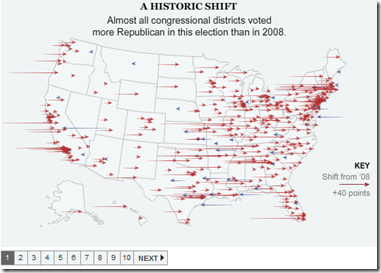
2010 Election Results
3 Nov 2010As usual, the best graphical analysis comes from the New York Times. Click through this map to understand the big shifts in the clearest possible way.


What is Chart Porn?
An addictive collection of beautiful charts, graphs, maps, and interactive data visualization toys -- on topics from around the world.
Categories
- Bailout (118)
- Chartporn Related (3)
- Commentary (21)
- Culture (669)
- Emerging Markets (66)
- Employment (245)
- Environment/weather (133)
- Finance (298)
- Food (92)
- Global Economy (373)
- Graphic Design (bad) (26)
- Graphic Design (general) (183)
- Graphic Tools (23)
- History (158)
- Housing (162)
- Humor (204)
- Innovative (183)
- Interactive (545)
- Internet/tech (97)
- Maps (578)
- News Media (34)
- Politics (329)
- Reference (97)
- Science (331)
- Source: Economist (101)
- Source: FT (92)
- Source: NYT (147)
- Source: Ritholtz (76)
- Source: USA Today (27)
- Source: Washington Post (90)
- Source: WSJ (135)
- Sports (58)
- Stock Market (74)
- Uncategorized (2)
- Updated regularly (76)
- US Economy (553)
- Video (22)
- Aram Korevaar: This chart is now being used as a projection in which countries such as China see themselves as in a [...]
- David: Welcome back Chart Porn! [...]
- J S: Thanks for the great story. Miss reading this blog. Hope to see you more active again. [...]
- jake: I lived in a DC row house for 6 years, and I'm writing this comment from my tiny 1 bedroom apartment [...]
- ronny pettersen: Hilarious and unfortunately accurate... ;-) [...]