
Interactive Archive:
Wall Street Compensation: 2010
2 Feb 2011In 2010, total compensation and benefits at publicly traded Wall Street banks and securities firms hit a record of $135 billion […] The total is up 5.7% from $128 billion in combined compensation and benefits by the same companies in 2009.
The interactive tree-map has a nice introduction of how it works, but it would have been nice to be able to drill down further to firm level data. On the two bottom graphs, they could have combined them using the same scale so it was easier to view the revenue/profit/compensation ratios. (related article)


The FT created an interactive bar chart of the IMF’s COFER data on foreign currency holdings. Watching the growth since 2006 is particularly stunning. Design wise, the dynamic resorting of the countries is an interesting variation.

Posted at the same time was a map of China’s imports with details clickable by country. This is all part of the FT’s in depth “China Shapes the World” feature.

Note: some Financial Times features require a subscription.
Global Inflation
31 Jan 2011An interactive heatmap of inflation across the globe, from the WSJ. Well done, but I would have expected some 2010 data in there by now.

Fun and Games with Airline Ticket Prices
In: Interactive Maps Reference
27 Jan 2011The Wall Street Journal has a nice article about the weekly ebbs and flows of airline ticket sales. If you want to dig deeper, farecompare.com has done some longer period analysis of this topic.

Flipping the typical fare question on it’s head, below is a very cool interactive map where you input how much you want to spend and it will show you where you can fly for that much money:

Kayak.com has also graphed a few charts of average ticket prices, and provides downloadable data:


Finally, since we’re on the topic, I want to give a Chart Porn graphic design gold star to Hipmunk’s flight reservation site. It’s what selecting a flight should look like:

The US Economy in Two Visualizations
In: Employment Finance Housing Interactive Maps Updated regularly US Economy
22 Jan 2011If you want to know the state of the US economy at any time, check out the below visualizations from Russell Investments and the AP. They are both updated monthly with the latest data, allow all kinds of drilling down, and both take the time to document sources and explain why you should give a shit about these particular numbers (for example, click on any of the “historical details” links on Russell’s dashboard).


Cross-Country Risks: Financial and Trade
In: Finance Global Economy Interactive Source: Washington Post
13 Jan 2011Cross-country financial and trade exposures are hard to visualize, but this interactive network diagram from the Washington Post is a good attempt. And the sovereign spread sparklines at the bottom are a nice addition.

I somehow missed catching this when it came out in December.
History of Global Health and Happiness (1960-2010)
In: History Interactive
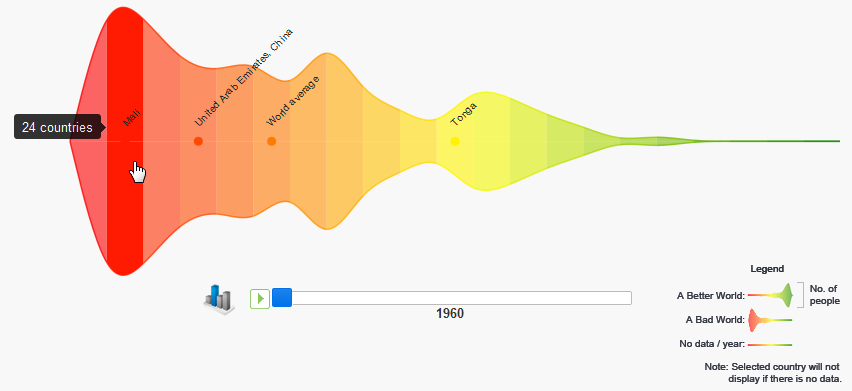
13 Jan 2011Using data from the World Bank’s open data initiative, this interactive tool let’s you pick from a variety of social indicators, then animate how the world’s countries perform over time. It’s basically a colorful histogram, and I know some people are critical of mirroring above and below the axis like this – but it sure is pretty. (via)
What You Don’t Know About Unemployment
11 Jan 2011We hear the big unemployment number each month (currently 9.4%), and we all know someone who’s been unemployed for a while. But how bad is it really? Let’s say I lost my job tomorrow – how bad is it out there for someone just like me? (note: if you click on the links you can enter your own attributes)
Geography?: Washington DC traditionally has higher unemployment, but it looks like that trend might soon reverse?

Age?: That’s good news. Someone my age has a slight advantage.

Sex?: Wow. I didn’t see that coming. Men have been disproportionately affected by this recession.

If you don’t mind that the data is from 2009, you can select all of the above and also add in education using the NYT visualization below. So all together, someone like me only faces a 3.9% unemployment rate – versus, say, a 15-24 yr old black male with no college, who faces a 48.5% unemployment rate. 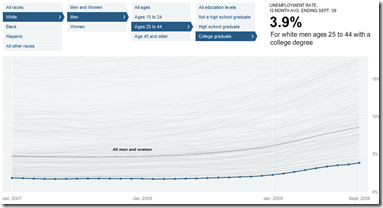
Another piece of the unemployment picture that doesn’t get much coverage is how different sectors are performing. Let’s take a look at jobs gained and lost since 2000 (note: this is in millions of jobs, not percent)

Manufacturing, construction, and retail have gotten clobbered, while government, health care, and education are about the only professions showing growth.
Well, I hope you found these tools enlightening and helped you understand that the one number they spend so much time talking about in the media doesn’t even begin to tell the whole story. If you want to dig further yourself, all of the raw data is available for download from the BLS.
Map: Factory Farms
In: Food Interactive Maps
7 Jan 2011Want to know how many cows live in your state? How about the average chickens per farm? The site obviously has a slight bias on food issues, but the data is well presented and the methodology is laid out clearly (something that is missing on too many data visualizations). Personally, I have no problem with killing animals and eating them, and agree that they shouldn’t suffer horribly crappy lives beforehand. (Related blog post).

Top Movies of 2010
In: Culture Interactive
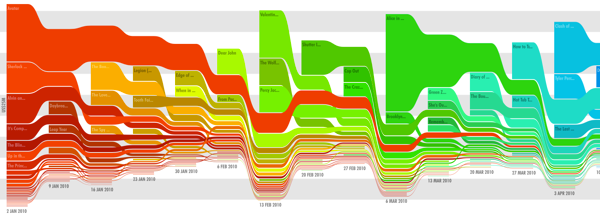
4 Jan 2011A beautiful stream graph of the top 25 movies of 2010, sized by box office gross per week. Created by Zach Beane – his site also includes similar graphs for earlier years. (via)

Economist: Top 20 Charts of 2010
In: Global Economy Graphic Design (general) Interactive Source: Economist
3 Jan 2011Interactive tree map of the top 20 charts viewed on the Economist’s website.

Life Flowchart: Love-Limbo-Trouble-Denial
23 Dec 2010Sony pictures sponsored these awesome flowcharts to promote the upcoming movie “How Do You Know”. The best part is you don’t see the whole chart at once – you make your choices, and it reveals just those results (why is this the first time I’ve seen this done!? It’s so simple.). Created by Jetset Studios.

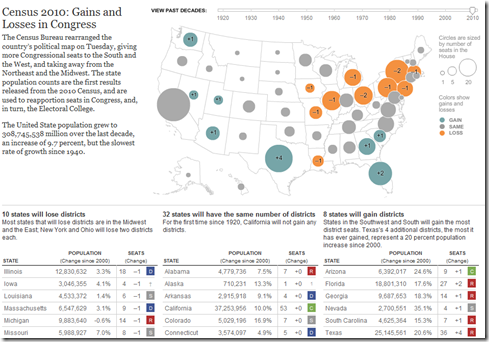
10 states will lose congressional districts (mostly in the northeast) ; 8 will gain (mostly in the south and southwest), and the other 32 will stay the same. The tables below the map show the change in state populations since 2000. You can also use the timeline to view the re-apportionments back to 1920. (related article; related NYT political blog; Census press release)
And the official total? There are 308,745,538 people in the United States.
Retail Sales by Business
In: Finance Interactive Source: WSJ Updated regularly US Economy
20 Dec 2010A beautiful data visualization of retail sales by type of business. I usually hate stacked bar charts because you really can’t compare what’s happening to any stack except the bottom and the total. The WSJ solves that problem by letting you click on any individual sector, which smoothly animates into a chart of just those bars. Well done! It would be interesting to see this done for the components of GDP.

Update: Philip Izzo pointed out to me that the WSJ’s interactive area chart of the Fed’s balance sheet (below) also allows the same kind of drill-down. In addition, both of these are updated regularly as new data is released.

Mapping America
15 Dec 2010The NYT’s has created a huge variety of interactive maps based on the Census Bureau’s American Community Survey. Click on “view more maps” to see different breakdowns (income, race, housing, education). Roll-overs popup details at the county or census area level. Related article.
Here’s the percentage of foreign born population in Washington DC:

Change in income level since 2000:

This one shows how racially divided DC still is (green vs blue)”:

They also used the data for some more detailed analysis, such as “How NYC’s Racial Makeup has changed since 2000” (clockwise from upper left: white, hipanic, asian, black). Related article.






What is Chart Porn?
An addictive collection of beautiful charts, graphs, maps, and interactive data visualization toys -- on topics from around the world.
Categories
- Bailout (118)
- Chartporn Related (3)
- Commentary (21)
- Culture (669)
- Emerging Markets (66)
- Employment (245)
- Environment/weather (133)
- Finance (298)
- Food (92)
- Global Economy (373)
- Graphic Design (bad) (26)
- Graphic Design (general) (183)
- Graphic Tools (23)
- History (158)
- Housing (162)
- Humor (204)
- Innovative (183)
- Interactive (545)
- Internet/tech (97)
- Maps (578)
- News Media (34)
- Politics (329)
- Reference (97)
- Science (331)
- Source: Economist (101)
- Source: FT (92)
- Source: NYT (147)
- Source: Ritholtz (76)
- Source: USA Today (27)
- Source: Washington Post (90)
- Source: WSJ (135)
- Sports (58)
- Stock Market (74)
- Uncategorized (2)
- Updated regularly (76)
- US Economy (553)
- Video (22)
- Aram Korevaar: This chart is now being used as a projection in which countries such as China see themselves as in a [...]
- David: Welcome back Chart Porn! [...]
- J S: Thanks for the great story. Miss reading this blog. Hope to see you more active again. [...]
- jake: I lived in a DC row house for 6 years, and I'm writing this comment from my tiny 1 bedroom apartment [...]
- ronny pettersen: Hilarious and unfortunately accurate... ;-) [...]