
Culture Archive:

Bible Sentiment
In: Culture Innovative
18 Oct 2011These types of positive/negative word content analysis usually raise more questions than they answer (and there is discussion on that over at FlowingData), but they sure are pretty.

China’s One Child Policy
6 Oct 2011I usually don’t post these info-posters, but this one does contain a lot of interesting information. (via)

The US Military – Maybe Not What You Think
5 Oct 2011Pew Research Center released a study on civilian and military views in the post 9/11 era. Headline MSM coverage (MSNBC; CNN) has focused on the finding that 1-out-of-3 veterans say the wars were not worth fighting – but the report actually contains a treasure trove of interesting graphics about our military.
The complete study in PDF format can be found here.


Cougars and Cubs
5 Oct 2011Using one of the more sexist charts in recent memory, the dating site whatsyourprice.com attempts to explain that the Ashton Kutcher/Demi Moore breakup is perfectly understandable. While this at first glance this resembles some of the quality revealed preference work done over at OkCupid, the selection bias here is quite large – along with a number of other flaws (as Adam Weinstein points out over at MotherJones).

DC Rock Venue Recognition Tree
30 Sep 2011If you live in Washington DC this will make sense to you.
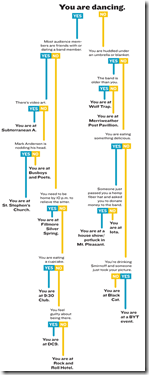
Hat tip to Jennifer D for sending it to me.
Proof That Mondays Suck
30 Sep 2011Cornell researchers analyzed mood content in 2.4million tweets (based on word choice) and found that Saturdays and Sunday garnered the most positive expressions and Mondays the most negative – well, during the day anyway. Interestingly, Saturday and Sunday nights were way up (down) there too. On a design note, perhaps the lower graph should have inverted the scale? (related article)

Female World Leaders
29 Sep 2011Just a simple reference graphic – FYI.

Choosing Sci-Fi and Fantasy Books
In: Culture
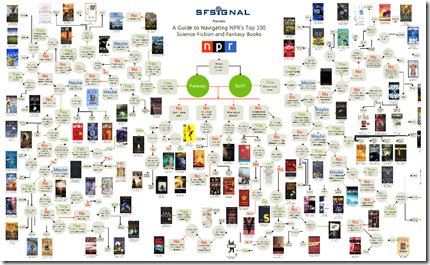
29 Sep 2011A flowchart for navigating topics, based on NPR’s list of top 100 books. Thanks to Mouse for sending it to me! (via)
Weather and Conception
26 Sep 2011Statistics indicate that more people are born in the fall (in the USA anyway), with the quick explanation being that we have more sex during the winter holidays (9 months earlier). GE takes a cut at this notion by comparing average temperatures and deviations from the national average birthrate. Statistically, however, using annual data adds enough noise in my mind to make drawing conclusions kind of tough. Anyone want to dig up the monthly data (even for one state) and do a lagged scatter plot? Hmmmm… how would you seasonally adjust this data?
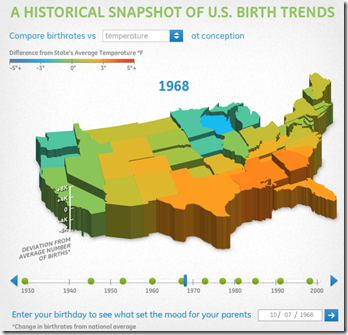
(one minor complaint: the 3d scale is interesting for comparing states, but you can’t tell what the values are for any of them because of the angle)
Sometimes a Stream is just a Stream
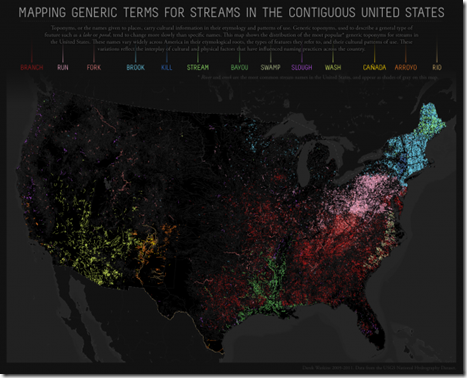
19 Sep 2011Regional preferences for what to call “streams” based on the USGS National Hydrography dataset.
Webcomic Frequency Chart
In: Culture
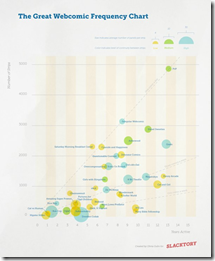
18 Sep 2011Who are the most prolific web comic authors? This chart lays out number of strips vs years active.
Author Venn
In: Culture
17 Sep 2011Do you agree? I’m not sure how Bukowski doesn’t at least overlap with Mouth, and Joyce smack in the middle?
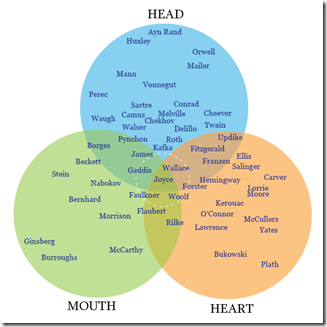
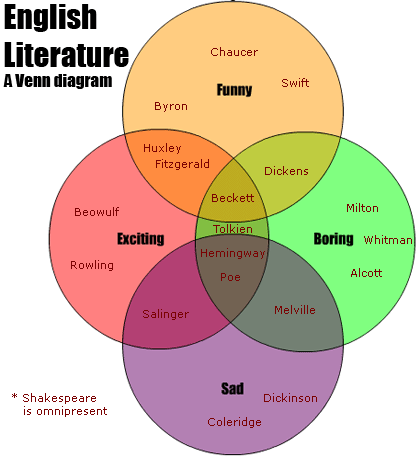
Here’s another version:
Newspapers (1690-2011)
16 Sep 2011Much like the post office timeline movie I posted last month, below we have the history of newspaper expansion across the USA. Interestingly, this movie is actually an extraction from a very well done interactive visualization of the Library of Congress’s newspaper database. You can even drill down to individual towns and see information about each newspaper. (via)
Original interactive version: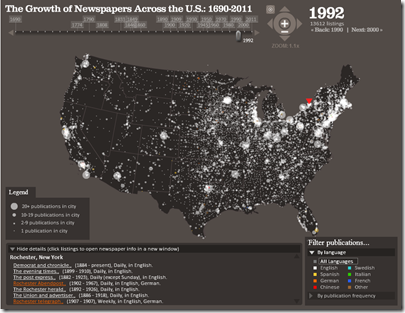
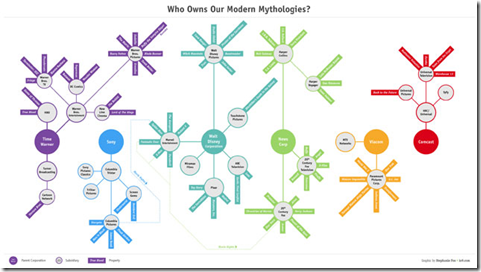
Who Owns Our Modern Mythologies?
In: Culture
9 Sep 2011What corporate monoliths own the rights to your favorite characters and stories?


What is Chart Porn?
An addictive collection of beautiful charts, graphs, maps, and interactive data visualization toys -- on topics from around the world.
Categories
- Bailout (118)
- Chartporn Related (3)
- Commentary (21)
- Culture (669)
- Emerging Markets (66)
- Employment (245)
- Environment/weather (133)
- Finance (298)
- Food (92)
- Global Economy (373)
- Graphic Design (bad) (26)
- Graphic Design (general) (183)
- Graphic Tools (23)
- History (158)
- Housing (162)
- Humor (204)
- Innovative (183)
- Interactive (545)
- Internet/tech (97)
- Maps (578)
- News Media (34)
- Politics (329)
- Reference (97)
- Science (331)
- Source: Economist (101)
- Source: FT (92)
- Source: NYT (147)
- Source: Ritholtz (76)
- Source: USA Today (27)
- Source: Washington Post (90)
- Source: WSJ (135)
- Sports (58)
- Stock Market (74)
- Uncategorized (2)
- Updated regularly (76)
- US Economy (553)
- Video (22)
- Aram Korevaar: This chart is now being used as a projection in which countries such as China see themselves as in a [...]
- David: Welcome back Chart Porn! [...]
- J S: Thanks for the great story. Miss reading this blog. Hope to see you more active again. [...]
- jake: I lived in a DC row house for 6 years, and I'm writing this comment from my tiny 1 bedroom apartment [...]
- ronny pettersen: Hilarious and unfortunately accurate... ;-) [...]