
Culture Archive:
Aries Criminals
4 Jan 2012An analysis of people arrested in Southwestern Ontario in 2011 by astrological sign. Anyone have a larger dataset?

Lego Brick Costs (1973-2011)
In: Culture
20 Dec 2011I like it when someone take a silly anecdotal observation and then does the research to see if it’s actually true. In this case, Ruth Suehle was wondering whether Legos really used to be cheaper when we were kids. The statistical methodology choices and related discussions over at GeekMom are interesting (though wonderfully pointless).

The Millennials
In: Culture
16 Dec 2011Using the faded “other” generation graphics really helps keep this one on focus (though the hands get a bit overused, perhaps).


Marriage on the Decline
14 Dec 2011The Washington Post added family type to it’s interactive map of census data (the map also allows you to filter over time, race, density, etc). You can zoom in and see how your county compares to the rest of the country. Interesting observations: Married people with children only make up 7% of Washington DC?!? Utah is one of the few remaining regions with high “married w/children” percentages, compared to previous years when it was more common across the country.
Just 51 percent of all adults who are 18 and older are married, placing them on the brink of becoming a minority, according to a Pew Research Center analysis of census statistics to be released Wednesday. That represents a steep drop from 57 percent who were married in 2000… In 1960, for example, when most baby boomers were children, 72 percent of all adults were married. The median age for brides was barely 20, and the grooms were just a couple of years older. (related article)

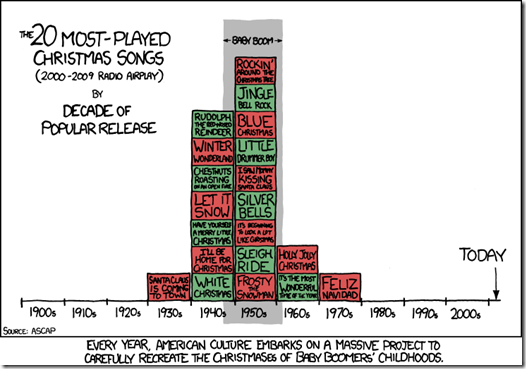
Christmas Carols
In: Culture
13 Dec 2011I’ve noticed this before – the same applies to “Christmas Movies” (with the exception of Bad Santa and South Park xmas shows, of course)
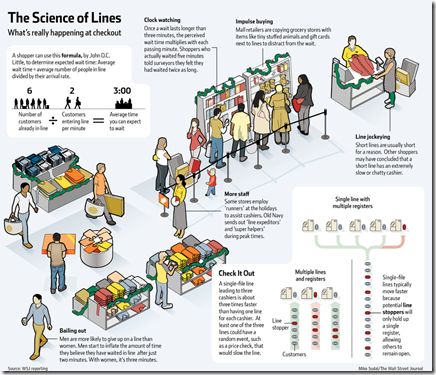
Which Checkout is Fastest?
8 Dec 2011The WSJ explains some of the science behind new checkout procedures you might be seeing this holiday season. I saw the one-to-many recently at a local Whole Foods and it reminded me a little too much of cows going to the slaughter house – but then, I hate lines of all kinds. Hat tip to Jennifer DuMars for sending it along. (related article)
Corruption and Development
5 Dec 2011Graphing the Corruption Perceptions Index vs the Human Development Index shows a pretty clear correlation. Of course, “perception” indices are always of dubious value.
4.74 Degrees of Separation
In: Culture Internet/tech
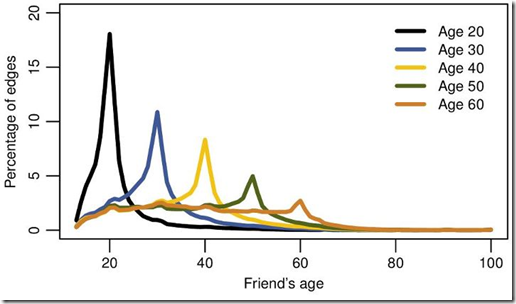
22 Nov 2011New research by Facebook based on user friends, reveals that there are not 6 degrees of separation between you and everyone else – but only 4.74. Other interesting tidbits: the distance is shrinking: in 2008 it was 5.28. If you just look at the United States, it’s only 4.

… 84% of all connections are between users in the same country. We also find that people tend to have a similar, albeit typically smaller, number of friends as their neighbors, and tend to be about the same age.

Sexperience
13 Nov 2011Based on a survey of 1000 British adults, this interactive display lets you select questions and filter answers in a variety of interesting charts, where each dot represents a person in the survey. The live animations are really cool, though some of the presentations are more effective than others.

European Twitter Languages
2 Nov 2011Eric Fischer analyzed twitter meta data for location and language and ended up with a pretty good approximation of the normal geopolitical borders. He chose grey for English, since they speak that everywhere – it would be interesting to see a map of just English. There’s also a world version. (via FlowingData)

Evolution of Western Dance Music
In: Culture Interactive Maps
2 Nov 2011An interactive timeline showing (roughly) the origins and evolution of different genres of dance music. I wish you could filter to see the connections a little clearer.

Death and Gravestone Symbolism
1 Nov 2011This is a strange little compendium of symbols. Half of these symbols are completely obvious, and I was ready to dismiss the whole thing as link-bait, but then there are a number of little gems that I never would have guessed. Also, when was the last time you saw a mono-spaced courier font used? It sort of works here, though overall there are a few too many different fonts strewn around. I also have to give credit that the source links at the bottom do indeed lead to more interesting information on the subject.


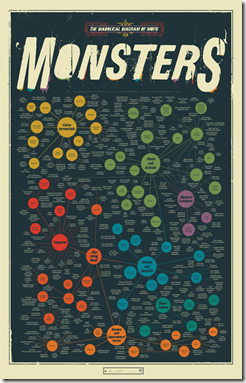
Movie Monsters
In: Culture
1 Nov 2011I have to say, this is a pretty thorough list – I’ve never heard of most of these. But, then, I’m not a big fan of scary movies. Available as a poster if you want one.
Scary Movies (1933-2006)
20 Oct 2011Halloween is next week! This graphic compares budget, box office revenue, and rotten tomatoes ratings of most of the classics.


What is Chart Porn?
An addictive collection of beautiful charts, graphs, maps, and interactive data visualization toys -- on topics from around the world.
Categories
- Bailout (118)
- Chartporn Related (3)
- Commentary (21)
- Culture (669)
- Emerging Markets (66)
- Employment (245)
- Environment/weather (133)
- Finance (298)
- Food (92)
- Global Economy (373)
- Graphic Design (bad) (26)
- Graphic Design (general) (183)
- Graphic Tools (23)
- History (158)
- Housing (162)
- Humor (204)
- Innovative (183)
- Interactive (545)
- Internet/tech (97)
- Maps (578)
- News Media (34)
- Politics (329)
- Reference (97)
- Science (331)
- Source: Economist (101)
- Source: FT (92)
- Source: NYT (147)
- Source: Ritholtz (76)
- Source: USA Today (27)
- Source: Washington Post (90)
- Source: WSJ (135)
- Sports (58)
- Stock Market (74)
- Uncategorized (2)
- Updated regularly (76)
- US Economy (553)
- Video (22)
- Aram Korevaar: This chart is now being used as a projection in which countries such as China see themselves as in a [...]
- David: Welcome back Chart Porn! [...]
- J S: Thanks for the great story. Miss reading this blog. Hope to see you more active again. [...]
- jake: I lived in a DC row house for 6 years, and I'm writing this comment from my tiny 1 bedroom apartment [...]
- ronny pettersen: Hilarious and unfortunately accurate... ;-) [...]