
Culture Archive:
History of Communication
10 Aug 2010This infographic is intriguing because the most interesting part: the graph of call costs is hidden behind the jumble of labels – I didn’t even notice it until Ben Edmonds pointed it out. For the heck of it, I’ve also linked to other communication timelines.


Church Attendance and Liars
9 Aug 2010A simple chart showing the percentage of europeans that never attend religious services. FYI, similar polls put the USA at 40%. But apparently, most people lie about this when asked.

Death Fees
In: Culture
9 Aug 2010Seems appropriate for a monday morning: A look at the costs associated with funerals. For the record, please roll my corpse into a hole in the woods and spend the money celebrating being alive.






God vs Satan
In: Culture
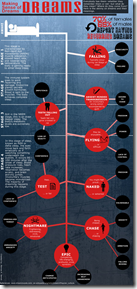
2 Aug 2010I tried to track down the original, but only discovered that this analysis has been around for a while. Here’s another version.

This is Burning Man
In: Culture
29 Jul 2010A fantastic infographic about the annual arts festival.

Global Executions
29 Jul 2010Yikes! Anybody want to re-jigger this to per-capita? Or does that not really matter in this case? Thoughts?

Losing Our Religion
In: Culture
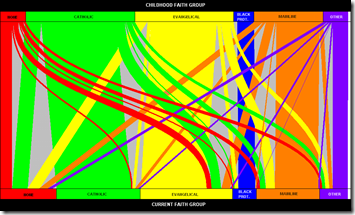
28 Jul 2010This graphic is based on a survey of the religious affiliations of adults (bottom) versus when they were children (top). One of the biggest winners: “None”.
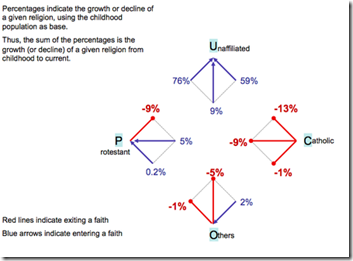
The Junk Charts blog attempted another way of visualizing the same data:
Modern Television
28 Jul 2010A videographic full of interesting charts and facts. For example: we all watch more television then we think we do.
Preventable Deaths
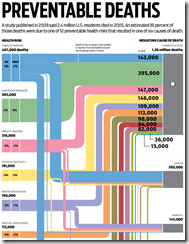
26 Jul 2010Interactive look at 12 preventable health risks that result in six different causes of death. A very nice design — if you ignore having to manually close the popups. (via Visual Loop)
Demographics (1950-2050)
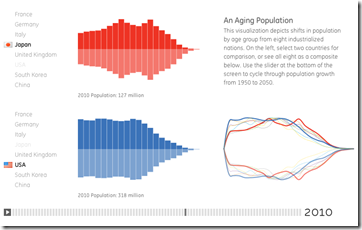
25 Jul 2010A very smooth interactive that allows you to compare the population composition of 8 countries over time. You can see some interesting trends by playing with the timeline control at the bottom — like watching the baby boom bulge move through the USA population then disappear, or the holes left in european age groups by WWII.
Tweet Mood Ring Maps
In: Culture Internet/tech Maps
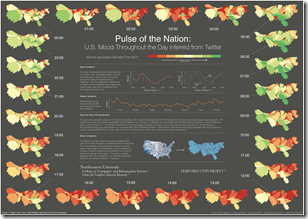
23 Jul 2010Researchers analyzed the words of 300 million tweets for “happiness” content and plotted the changes over time. The findings are kind of cool, but this would have looked a lot better with non-contiguous cartograms.
26 Infographics on Child Obesity
20 Jul 2010A contest from Good magazine produced a number of different designs. The winner will be announced next week.


What is Chart Porn?
An addictive collection of beautiful charts, graphs, maps, and interactive data visualization toys -- on topics from around the world.
Categories
- Bailout (118)
- Chartporn Related (3)
- Commentary (21)
- Culture (669)
- Emerging Markets (66)
- Employment (245)
- Environment/weather (133)
- Finance (298)
- Food (92)
- Global Economy (373)
- Graphic Design (bad) (26)
- Graphic Design (general) (183)
- Graphic Tools (23)
- History (158)
- Housing (162)
- Humor (204)
- Innovative (183)
- Interactive (545)
- Internet/tech (97)
- Maps (578)
- News Media (34)
- Politics (329)
- Reference (97)
- Science (331)
- Source: Economist (101)
- Source: FT (92)
- Source: NYT (147)
- Source: Ritholtz (76)
- Source: USA Today (27)
- Source: Washington Post (90)
- Source: WSJ (135)
- Sports (58)
- Stock Market (74)
- Uncategorized (2)
- Updated regularly (76)
- US Economy (553)
- Video (22)
- Aram Korevaar: This chart is now being used as a projection in which countries such as China see themselves as in a [...]
- David: Welcome back Chart Porn! [...]
- J S: Thanks for the great story. Miss reading this blog. Hope to see you more active again. [...]
- jake: I lived in a DC row house for 6 years, and I'm writing this comment from my tiny 1 bedroom apartment [...]
- ronny pettersen: Hilarious and unfortunately accurate... ;-) [...]