
Author Archive
Population Pyramids
23 Jan 2012I’ve loved these types of charts since I first saw them used for insight into the Arab Spring discontent. What’s great about the version linked below is the country coverage that Worldlifeexpectancy.com has managed to pull together – it’s very impressive. If you wander the site, there are a lot of additional maps and charts on global causes of death, life expectancy, and other fun demographic topics. (via)


On a design note: Wow. I haven’t seen someone attempt a black background and glowing neon fonts in such a manner since the earliest days of the internet. I don’t know whether to applaud the boldness and bust out some glowsticks, or put on sunglasses to prevent a seizure. I suppose since it’s all about death, the black kinda works.

100 Best Companies to Work For (2012)
20 Jan 2012
The Fortune Magazine website for this study has lots of related articles and indicators. My favorite it the interactive “Perkfinder” – you select the benefits most important to you, and it tells you which of the top 100 companies provide them:

Discordianism
20 Jan 2012
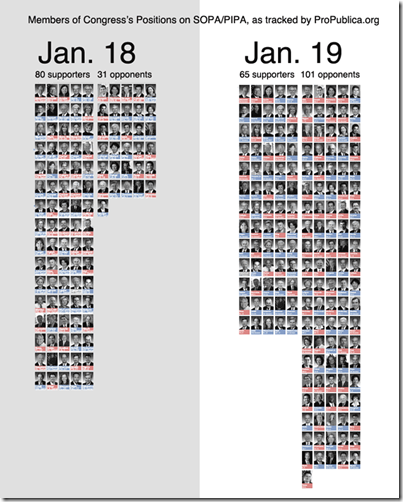
SOPA Opera
In: Politics
20 Jan 2012Democracy in action? or Congress blowing with the wind?
A brilliant chart of computer sales. Note the log scale!

There’s also an animated version (but I like the static one better):
Here’s a look at the same data in terms of market share:

(via Ritholtz)
Financial Crises (1810-2010)
18 Jan 2012A new graphic from HistoryShots, based on Reinhart & Rogoff’s well researched book: This Time Is Different: Eight Centuries of Financial Folly. The top half of the chart maps financial crises in terms of GDP affected, while the bottom indicates number of sovereign defaults.

I just ordered a copy. If you’re into this long-term economic history stuff, check out US Booms and Busts (1775-1943).
Where the Trees Are
18 Jan 2012A new high resolution (down to 30m) map of US forests created using a compilation of data from “space-based radar, satellite sensors, computer models, and a massive amount of ground-based data.” There’s also a detailed article about the project and the decisions that went into it. I guess I knew the midwest was sparse – but I didn’t think it was THAT sparse.

Ushahidi Visualization Platform
17 Jan 2012Ushahidi is a non-profit tech developer of free and open source software for collecting and real-time visualization crowd-sourced information. The project originated in a desire to map post-election violence in Kenya back in 2008 – but it has since expanded into a number of free toolsets that can be set up quickly during emergencies. To be honest, I haven’t dived too deep into this, but I wanted to post it in case others have a need.

What Jobs are the 1% Doing?
17 Jan 2012A treemap of the jobs that the 1% are doing – showing a lot of variety. I wish there was more detail about the dataset source. The related article provides some anecdotal examples.

What Percent Are You?
In: Culture Employment Interactive Maps Source: NYT US Economy
17 Jan 2012Enter your household income and see where you rank in 344 areas around the country:

There’s some interesting behind the scenes information on the news paper version here:

Retail Sales
In: Graphic Design (general) Innovative Source: WSJ US Economy
13 Jan 2012Here’s an example of how more isn’t always better. Compare the interactive presentation of retail sales data below to the static version – both from the Wall Street Journal. In my opinion the static version presents the information in a much clearer and usable format. The only thing it’s missing is a chart for “total retail sales”. Regarding the interactive version, I’ve never liked stacked bar charts over time unless they illustrate very clear trends – with this many similar segments I think they are pretty silly (though the ability to drill down does alleviate this a smidgeon). (related article)


The World According to San Francisco
12 Jan 2012This is pretty damn funny. Thanks to Rebecca Southers for passing it on!

The Big Numbers
12 Jan 2012Some of the data points here are interesting, but I think it throws together too many different data types. Mass fatalities count as “Human Gatherings”?!? The colors are beyond drab, and the spiral just adds to the confusion. In summary: Ick.

Gold
12 Jan 2012Some pretty interesting facts about gold.


What is Chart Porn?
An addictive collection of beautiful charts, graphs, maps, and interactive data visualization toys -- on topics from around the world.
Categories
- Bailout (118)
- Chartporn Related (3)
- Commentary (21)
- Culture (669)
- Emerging Markets (66)
- Employment (245)
- Environment/weather (133)
- Finance (298)
- Food (92)
- Global Economy (373)
- Graphic Design (bad) (26)
- Graphic Design (general) (183)
- Graphic Tools (23)
- History (158)
- Housing (162)
- Humor (204)
- Innovative (183)
- Interactive (545)
- Internet/tech (97)
- Maps (578)
- News Media (34)
- Politics (329)
- Reference (97)
- Science (331)
- Source: Economist (101)
- Source: FT (92)
- Source: NYT (147)
- Source: Ritholtz (76)
- Source: USA Today (27)
- Source: Washington Post (90)
- Source: WSJ (135)
- Sports (58)
- Stock Market (74)
- Uncategorized (2)
- Updated regularly (76)
- US Economy (553)
- Video (22)
- Aram Korevaar: This chart is now being used as a projection in which countries such as China see themselves as in a [...]
- David: Welcome back Chart Porn! [...]
- J S: Thanks for the great story. Miss reading this blog. Hope to see you more active again. [...]
- jake: I lived in a DC row house for 6 years, and I'm writing this comment from my tiny 1 bedroom apartment [...]
- ronny pettersen: Hilarious and unfortunately accurate... ;-) [...]