
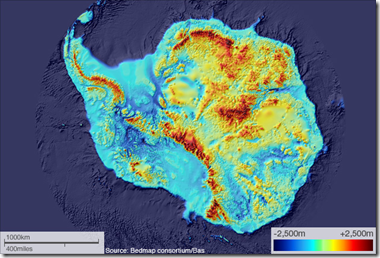
Using ice penetrating radar, scientists have mapped out the ground and mountains that lie beneath Antarctica’s ice sheets. The project is interesting because it draws on decades of work from many different teams and datasets, and will help create more accurate models of melt rates.

Comment Form


What is Chart Porn?
An addictive collection of beautiful charts, graphs, maps, and interactive data visualization toys -- on topics from around the world.
Categories
- Bailout (118)
- Chartporn Related (3)
- Commentary (21)
- Culture (669)
- Emerging Markets (66)
- Employment (245)
- Environment/weather (133)
- Finance (298)
- Food (92)
- Global Economy (373)
- Graphic Design (bad) (26)
- Graphic Design (general) (183)
- Graphic Tools (23)
- History (158)
- Housing (162)
- Humor (204)
- Innovative (183)
- Interactive (545)
- Internet/tech (97)
- Maps (578)
- News Media (34)
- Politics (329)
- Reference (97)
- Science (331)
- Source: Economist (101)
- Source: FT (92)
- Source: NYT (147)
- Source: Ritholtz (76)
- Source: USA Today (27)
- Source: Washington Post (90)
- Source: WSJ (135)
- Sports (58)
- Stock Market (74)
- Uncategorized (2)
- Updated regularly (76)
- US Economy (553)
- Video (22)
- Aram Korevaar: This chart is now being used as a projection in which countries such as China see themselves as in a [...]
- David: Welcome back Chart Porn! [...]
- J S: Thanks for the great story. Miss reading this blog. Hope to see you more active again. [...]
- jake: I lived in a DC row house for 6 years, and I'm writing this comment from my tiny 1 bedroom apartment [...]
- ronny pettersen: Hilarious and unfortunately accurate... ;-) [...]
4 Responses to Antarctica’s Underground
John F. Opie
December 6th, 2011 at 07:36
Did they figure out which ones are the Mountains of Madness? Us Lovecraft fans want to know! 🙂
Ryan
December 7th, 2011 at 12:42
I found this fascinating but poorly described by the BBC article. While the maps presented do a great job of illustrating the peaks and troughs of the landscape, it gives me no reference to what the ice covers up and what it does not.
Are those highest peaks COMPLETELY underneath ice? Are the deepest troughs completely filled in with ice? So to someone standing on the surface Antartica is one giant completely flat plane? I presume it isn’t and would therefore be more fascinated if I could understand where the ice layer resides in reference to these factors.
alekseiy
December 13th, 2011 at 21:08
@ryan: the bbc article states in its 3rd paragraph:
“It is remarkable to think that less than 1% of this rock base projects above the continent’s frozen veil.”
so, yes: those highest peaks are almost completely covered with ice and those throughs are filled with it.
Paoloo
December 20th, 2011 at 14:47
Piris Reis found that 500 years ago, so it’s not a discovery.