
Hollywood Career-o-Matic
In: Culture Interactive
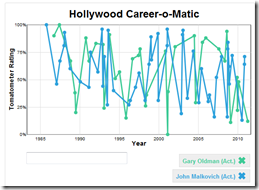
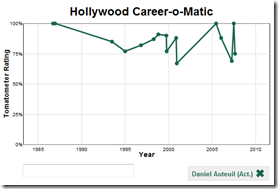
15 Jun 2011Chart the career of major actors and directors, based on Rotten Tomatoes’ aggregation of reviews – just type in who you want to see. Below are John Malkovich and Gary Oldman (who have had very busy diverse careers), and Daniel Auteuil, who has the highest consistent rating. If nothing else, it’s a cool way to explore movies – the rollovers remind you of precisely what bombs you have been erasing from your memory. (via FlowingData)
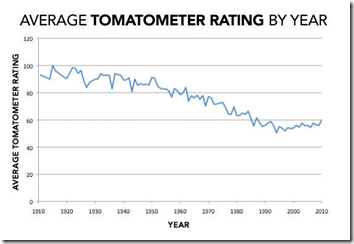
The Slate article also compiles some interesting aggregate stats. For example, on average, movies have been getting worse:
Comment Form


What is Chart Porn?
An addictive collection of beautiful charts, graphs, maps, and interactive data visualization toys -- on topics from around the world.
Categories
- Bailout (118)
- Chartporn Related (3)
- Commentary (21)
- Culture (669)
- Emerging Markets (66)
- Employment (245)
- Environment/weather (133)
- Finance (298)
- Food (92)
- Global Economy (373)
- Graphic Design (bad) (26)
- Graphic Design (general) (183)
- Graphic Tools (23)
- History (158)
- Housing (162)
- Humor (204)
- Innovative (183)
- Interactive (545)
- Internet/tech (97)
- Maps (578)
- News Media (34)
- Politics (329)
- Reference (97)
- Science (331)
- Source: Economist (101)
- Source: FT (92)
- Source: NYT (147)
- Source: Ritholtz (76)
- Source: USA Today (27)
- Source: Washington Post (90)
- Source: WSJ (135)
- Sports (58)
- Stock Market (74)
- Uncategorized (2)
- Updated regularly (76)
- US Economy (553)
- Video (22)
- Aram Korevaar: This chart is now being used as a projection in which countries such as China see themselves as in a [...]
- David: Welcome back Chart Porn! [...]
- J S: Thanks for the great story. Miss reading this blog. Hope to see you more active again. [...]
- jake: I lived in a DC row house for 6 years, and I'm writing this comment from my tiny 1 bedroom apartment [...]
- ronny pettersen: Hilarious and unfortunately accurate... ;-) [...]
2 Responses to Hollywood Career-o-Matic
Luke Noel-Storr
June 16th, 2011 at 06:26
“For example, on average, movies have been getting worse”
Surely its, at least partially, more the case that people are only unlikely to go back and review old films if they are considered “classic” movies. I strongly suspect that there aren’t many online reviews for 1910 films that were posted at the time. Also, many films from earlier years have only survived at all due to being classics.
The dip from the 60s to the end of the 80s can probably be explained by greater number of films from those periods surviving in peoples memories (and DVD collections), and so moving towards a stable average.
There actually seems to be a gradual upwards trend for films released from the 90s onwards, so it could be argued that films are, in fact, getting better.
It would be interesting to see another line on that graph representing the number of films from each year for which they are reviews.
Aaron
June 19th, 2011 at 21:01
Have to strongly agree with the first poster, here. That final graph is measuring two things: 1) The difficulty of preserving old films, resulting in the “Sharktopuses” of yesteryear being lost to age, fires and deliberate discarding. 2) The fact that a movie made 50 years ago is likely to be reviewed online primarily by those who did not see it when it was released, making them a self-selected sample group, with all of the inherent selection bias that implies.
I’m reminded of the best example of selection bias I’ve ever heard of: dolphins like to save stranded sailors by pushing them to land. Actually, it’s more likely that dolphins like to play by pushing stranded sailors around and those who are pushed toward land tend to survive to tell the tale. Same basic idea at work, here.