
Archive for October, 2009
US Debt
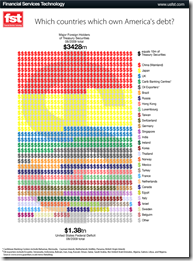
13 Oct 2009Who owns the United States debt?
How to Crack a Combination Lock
13 Oct 2009Simple instructions on how to break into a Master combo lock in less than 100 attempts (instead of trying all 64,000 possible combinations). (via)

Nobelity
13 Oct 2009A timeline of Nobel Peace Prize award winners since 1994:

and the pre-announcement bookie odds on who the winner was going to be:

Brain Awards
13 Oct 2009A table of how much various annual achievement awards pay out.

GOLD!
13 Oct 2009An annotated timeline of landmarks in gold prices.

Currency Trends
In: Emerging Markets Finance Global Economy Interactive Source: FT US Economy
13 Oct 2009The FT takes a graphic look at a number of currency trends (dollar/euro, carry trade, commodity currencies, the renminbi, and a trade weighted exchange index). [the links on the below images all go to the same interactive tool]


Health Care Bill Comparison
13 Oct 2009Interactive of the cost, coverage, and provisions of congress’s three health care bills.

Your Brain on God
8 Oct 2009Sort of an interactive article on recent brain research related to spiritual experiences, drill down through different topics and more detailed write-ups.

Nuclear Weapons
8 Oct 2009A decent infographic of nuclear weapons around the world. Having watched a documentary last weekend on what would happen to Washington DC after just a small detonation, I found this graphic and accompanying article interesting (I thought China had more, for example). (via)

What countries have improved the most since 1990? (it’s an index of life expectancy, literacy, education, and per capita GDP).

Income Inequality
8 Oct 2009As usual, Michael Moore isn’t completely right, but the distribution of income growth isn’t what it used to be.
Two-thirds of the country’s total gains in the five years to 2007 accrued to the top 1%, whereas the bottom 90th percentile saw only 12% of the extra income.

Flu Tracker
In: Maps Science Source: WSJ
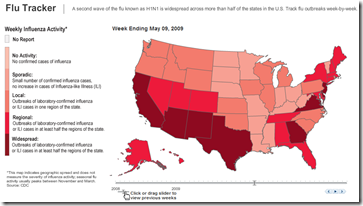
8 Oct 2009There are a lot of these maps out there. This one is interesting because the historical week-by-week animation illustrates the seasonality of the outbreak.
Atheism on the Rise
In: Culture
7 Oct 2009Another example of the data being hidden by poor design. Can you read the charts? Can you even find them? It took me a minute of scrolling around to locate the atheism chart.

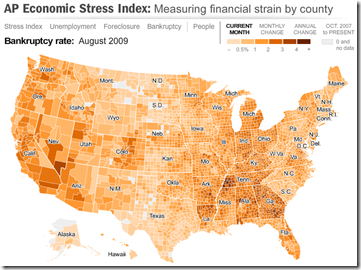
The well designed map displays unemployment, foreclosures, bankruptcy, or a composite “stress index”, by county. In the upper right you can change the period the %-change is calculated for (try it, it’s pretty nifty). To look at data over time, click on the “Oct.2007 to present” option and a historical slider will appear at the bottom (very slick to play with). Double click on a region to zoom in; click & hold to move around.
Instrumental Range
6 Oct 2009A wonderful interactive chart showing the frequency range of various musical instruments and how they correspond to human hearing.


What is Chart Porn?
An addictive collection of beautiful charts, graphs, maps, and interactive data visualization toys -- on topics from around the world.
Categories
- Bailout (118)
- Chartporn Related (3)
- Commentary (21)
- Culture (669)
- Emerging Markets (66)
- Employment (245)
- Environment/weather (133)
- Finance (298)
- Food (92)
- Global Economy (373)
- Graphic Design (bad) (26)
- Graphic Design (general) (183)
- Graphic Tools (23)
- History (158)
- Housing (162)
- Humor (204)
- Innovative (183)
- Interactive (545)
- Internet/tech (97)
- Maps (578)
- News Media (34)
- Politics (329)
- Reference (97)
- Science (331)
- Source: Economist (101)
- Source: FT (92)
- Source: NYT (147)
- Source: Ritholtz (76)
- Source: USA Today (27)
- Source: Washington Post (90)
- Source: WSJ (135)
- Sports (58)
- Stock Market (74)
- Uncategorized (2)
- Updated regularly (76)
- US Economy (553)
- Video (22)
- Aram Korevaar: This chart is now being used as a projection in which countries such as China see themselves as in a [...]
- David: Welcome back Chart Porn! [...]
- J S: Thanks for the great story. Miss reading this blog. Hope to see you more active again. [...]
- jake: I lived in a DC row house for 6 years, and I'm writing this comment from my tiny 1 bedroom apartment [...]
- ronny pettersen: Hilarious and unfortunately accurate... ;-) [...]