
Archive for October, 2009
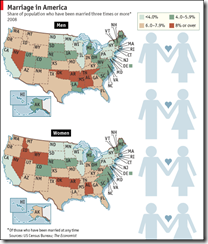
If at First (or second) You Don’t Succeed
21 Oct 2009Percent of population that has been married three times or more (of those that have ever been married).
Coal Plants
21 Oct 2009Coal is central to a lot of energy and environment issues, but I’d never seen a map of where they were.

Health Spending Map
In: Maps Politics US Economy
20 Oct 2009Would have been more useful in per capita, obviously

Stars and Stripes
20 Oct 2009More trivia than you can shake a flag at. (via)


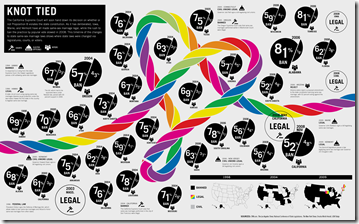
History of Gay Marriage
20 Oct 2009infographic of the various referendums (as of May 09)
Human Transportation
20 Oct 2009Similar in concept to the US McDonalds map, this map colors how long it takes to get to a city of 50,000 people from any location in the world. (via Simple Complexity & Visual Complexity)

the same New Scientist gallery has a map of roads, trains, shipping lanes, and navigable rivers (we’re pretty much everywhere).


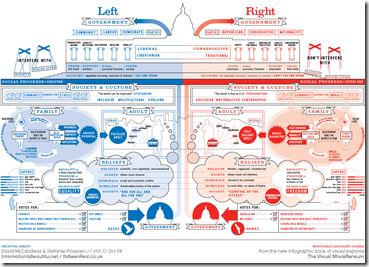
Two Party Statistics
In: Politics
20 Oct 2009A wonderful infographic from Information is Beautiful, from David’s upcoming book The Visual Miscellaneum. Also, an interesting bit of political trivia: Switzerland and the United States are the only countries where red=right wing and blue=liberal; every where else it’s the other way around.
DC Tunnels
19 Oct 2009Infographic of how the new portions of DC’s metro will be built. Related article. (via KelsoCartography)

BBC G20
In: Bailout Emerging Markets Finance Global Economy Interactive Maps Politics US Economy
19 Oct 2009A bit dated as these were prepared in the lead up to the Pittsburgh summit a few weeks ago. Worth passing on nonetheless.

A checklist of the G20’s April London Summit pledges and whether they’ve been fulfilled. Included some nice graphics on IMF and tax reforms.


G20 Stimulus and Fiscal Deficit map. Use the slider to look at the changes 2007-2010. Mouse over a country to view popup data details.

Inspired
18 Oct 2009Chartporn made it onto InspiredMag‘s list of “20 Essential Infographics and Data Visualization Blogs“. Lots of good company on that list. Thanks!

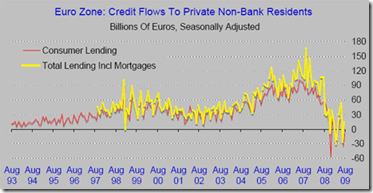
EU: Lending Down
18 Oct 2009We’ve seen this data before for the United States. The below chart confirms the same for the EU: banks are not lending.
NPR Economy Map
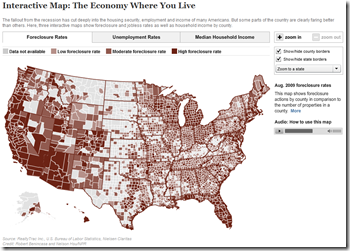
18 Oct 2009Foreclosures, unemployment, and median household income. The scales are a little vague on two of the maps — but it’s ok for broad comparative purposes.
Best City to be Unemployed?
18 Oct 2009Major U.S. cities ranked by their ratio of job postings to unemployed people. Looks like they update this regularly. Spotted over at SimpleComplexity.


What is Chart Porn?
An addictive collection of beautiful charts, graphs, maps, and interactive data visualization toys -- on topics from around the world.
Categories
- Bailout (118)
- Chartporn Related (3)
- Commentary (21)
- Culture (669)
- Emerging Markets (66)
- Employment (245)
- Environment/weather (133)
- Finance (298)
- Food (92)
- Global Economy (373)
- Graphic Design (bad) (26)
- Graphic Design (general) (183)
- Graphic Tools (23)
- History (158)
- Housing (162)
- Humor (204)
- Innovative (183)
- Interactive (545)
- Internet/tech (97)
- Maps (578)
- News Media (34)
- Politics (329)
- Reference (97)
- Science (331)
- Source: Economist (101)
- Source: FT (92)
- Source: NYT (147)
- Source: Ritholtz (76)
- Source: USA Today (27)
- Source: Washington Post (90)
- Source: WSJ (135)
- Sports (58)
- Stock Market (74)
- Uncategorized (2)
- Updated regularly (76)
- US Economy (553)
- Video (22)
- Aram Korevaar: This chart is now being used as a projection in which countries such as China see themselves as in a [...]
- David: Welcome back Chart Porn! [...]
- J S: Thanks for the great story. Miss reading this blog. Hope to see you more active again. [...]
- jake: I lived in a DC row house for 6 years, and I'm writing this comment from my tiny 1 bedroom apartment [...]
- ronny pettersen: Hilarious and unfortunately accurate... ;-) [...]
Blame the Smart People?
In: Bailout Commentary Finance Humor Source: WSJ US Economy
18 Oct 2009A WSJ op-ed that presents a convincing argument that we can’t blame stupid people for the financial crisis (though they certainly helped).