
Archive for October, 2009

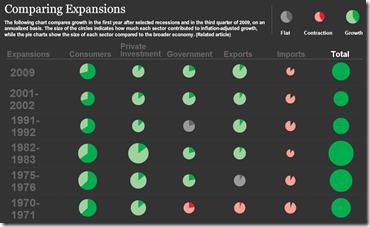
GDP Recovery Trends
30 Oct 2009Lots of information here. What drew my eye was the size of the circles, which indicate how much each sector contributed to growth/contraction. I’m not sure what the sizes of the circles in the total column are supposed to be. Related WSJ article.
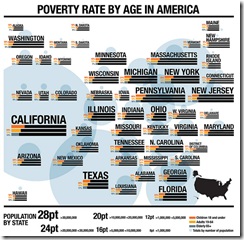
Poverty in America
30 Oct 2009An interesting way to show geographic data that is obviously weighted by population – the author created a cloud of rough geographic position, but varied the size of the graphs by population.
Visualizing Size
In: Innovative Science
30 Oct 2009A very cool and well designed zoomable comparison of relative microscopic sizes. I particularly like the variable scale in the corner. (via FlowingData and Information Aesthetics)

It’s Alive!!!
In: Humor US Economy
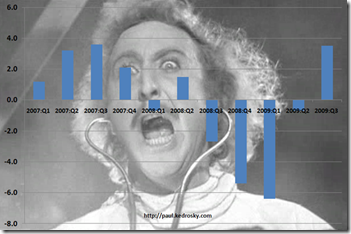
29 Oct 2009I couldn’t help but laugh at Infectious Greed’s response to today’s Q3 GDP numbers.
Turns out coursing a few gigavolts of financial stimulus current through even an economy the size of the U.S. will still get Frankenstein off the slab, however briefly.
Fun with Weekly Data
In: Graphic Design (general) Innovative Reference US Economy
29 Oct 2009This is a bit old (the data ends in July ’08), but I like this animated approach to displaying high frequency data over time. Something like this might be interesting to do for cross-country financial data-series.

Impressively, Jon Peltier came up with a way to do this in excel (and check out his blog for other really cool excel chart tricks and solutions)

Global Life and Death
29 Oct 2009A data packed international comparison of health statistics. I give Good a lot of grief for the design of some of their infographics, but this one is well done. (via Simple Complexity)

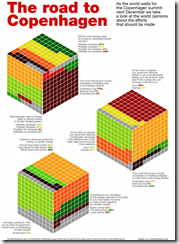
World Opinions on Climate Change
29 Oct 2009An interesting use of 3d cubes to display polling results. The polling questions are also much better constructed than the usual “do you think climate change is happening?”
Percent of married population now divorced or separated, by age.

Going for Broke
In: Culture Finance US Economy
28 Oct 2009
Swine Flu Mortality
28 Oct 2009This comparison of H1N1 deaths to other causes should help us keep our perspective (of course, you should also consider deaths among certain risk groups).

Rigged Trade Rules
In: Global Economy
27 Oct 2009Oxfam has produced a series of six simple, but effective and entertaining, animations that argue how global trade practices are hurting developing countries.

Timeline of recession and recovery (the Adversity Index) from Moodys/MSNBC (1995-2009). You can drill down to individual metro areas by clicking on a state. The Adversity Index page has a number of related articles.

There’s also a map of “recession resistant areas” (has had no more than 9 months of recession over the past 15 years).

Before and After Humans
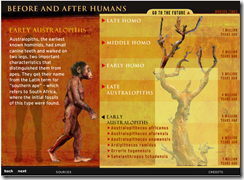
27 Oct 2009This is part informative and part just plain weird. The informative part is that you can click through the past 7 million years of the human evolutionary tree and view summaries of basic characteristics. The weird part is that it also allows you to click through the next 4 million years and see summaries of how we’re going to mess ourselves up. Apparently this is part of MSNBC’s “Fast Forward: The Future of Evolution” feature.

Who Owns Mortgages?
In: Finance Housing US Economy
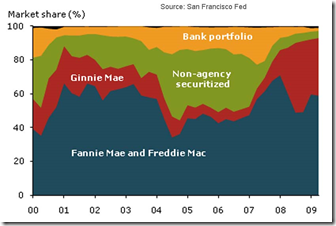
26 Oct 2009Fannie Mae and Freddie Mac combined have consistently been the largest players in the market, owning or guaranteeing about half or more of the mortgages in the sample at any given time. Non-agency securitization peaked in the first quarter of 2006, when it accounted for nearly 40% of new originations. Finally, the share of mortgages retained in the originating institution’s portfolio averaged about 15% throughout the boom, but has fallen considerably since. (from SF Fed via Calculated Risk)


What is Chart Porn?
An addictive collection of beautiful charts, graphs, maps, and interactive data visualization toys -- on topics from around the world.
Categories
- Bailout (118)
- Chartporn Related (3)
- Commentary (21)
- Culture (669)
- Emerging Markets (66)
- Employment (245)
- Environment/weather (133)
- Finance (298)
- Food (92)
- Global Economy (373)
- Graphic Design (bad) (26)
- Graphic Design (general) (183)
- Graphic Tools (23)
- History (158)
- Housing (162)
- Humor (204)
- Innovative (183)
- Interactive (545)
- Internet/tech (97)
- Maps (578)
- News Media (34)
- Politics (329)
- Reference (97)
- Science (331)
- Source: Economist (101)
- Source: FT (92)
- Source: NYT (147)
- Source: Ritholtz (76)
- Source: USA Today (27)
- Source: Washington Post (90)
- Source: WSJ (135)
- Sports (58)
- Stock Market (74)
- Uncategorized (2)
- Updated regularly (76)
- US Economy (553)
- Video (22)
- Aram Korevaar: This chart is now being used as a projection in which countries such as China see themselves as in a [...]
- David: Welcome back Chart Porn! [...]
- J S: Thanks for the great story. Miss reading this blog. Hope to see you more active again. [...]
- jake: I lived in a DC row house for 6 years, and I'm writing this comment from my tiny 1 bedroom apartment [...]
- ronny pettersen: Hilarious and unfortunately accurate... ;-) [...]